
A hospital stay can be one of the most demanding experiences for an older adult and the people who care about them. Medical treatment is naturally the first priority, but families quickly discover that many other needs continue throughout the hospital journey. A parent may need companionship when family members cannot stay at the hospital all day. After spending days or weeks away from home, a senior may want a haircut or nail care to feel comfortable and more like themselves again. Then, when discharge day finally arrives, another question appears: who will come to the hospital, help them leave, and make sure they have a reliable ride home?
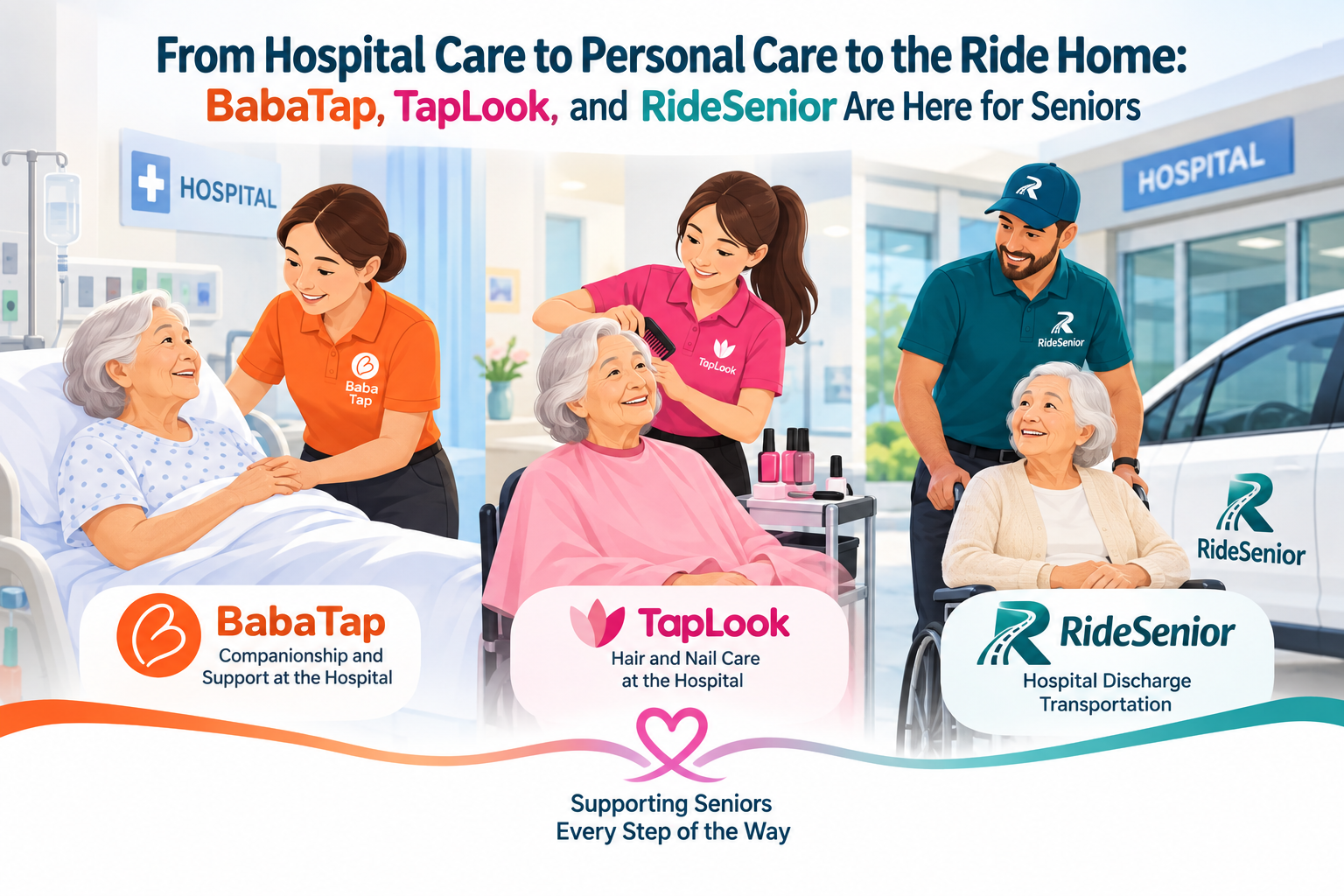
These may seem like separate needs, but for seniors and their families they are often parts of one continuous experience. That is the idea behind BabaTap, TapLook, and RideSenior. Each brand has a different purpose, but together they can provide practical support at different stages of a senior’s hospital journey. BabaTap focuses on companionship and practical non-medical support. TapLook brings mobile hair and nail care to clients, including eligible clients in hospitals where such services are permitted. RideSenior focuses on senior-friendly transportation, including Hospital Discharge Transportation and optional Hospital Pickup Assistance.
The goal is not to replace hospitals, nurses, physicians, home care agencies, family caregivers, ambulances, or other healthcare professionals. These three services are designed to complement the medical and family support already surrounding an older adult. They focus on everyday needs that can become surprisingly difficult to coordinate during a hospital stay.
Consider a common situation. An older parent is admitted to hospital and remains there longer than originally expected. Their adult children have jobs and families of their own and cannot always stay beside them. As the senior begins feeling better, they may become more interested in their usual routines and personal appearance. Eventually, the hospital announces that discharge is approaching, but the family cannot arrive at the required time to provide transportation. Instead of searching for several unrelated providers at each stage, families can turn to a network in which each service has a clearly defined role.
This is what the connection between BabaTap, TapLook, and RideSenior is intended to accomplish. It is not one company trying to make one person perform every task. It is three specialized service brands addressing three different needs while sharing the same broader objective: making everyday life easier for seniors and their families.
BabaTap: Companionship and Practical Support at the Hospital
When an older adult is admitted to hospital, family members naturally want to be present as much as possible. They visit, talk with their loved one, provide reassurance, help them remain connected with family, and simply sit beside them during long periods when there may be little to do. That human presence can be deeply meaningful, particularly for seniors who are accustomed to spending their days at home surrounded by familiar people and routines.
The reality, however, is that families cannot always be at the hospital. Adult children may be working during the day, caring for their own children, or living in another city. A spouse may also be a senior and may not have the physical stamina to spend ten or twelve hours at the hospital every day. Other families may be able to visit regularly but still need help covering certain periods of the day.
BabaTap is designed to help address this practical gap through companionship and non-medical senior support. Where permitted by the hospital and appropriate for the individual, a BabaTap Pro can spend time with a senior, provide companionship, engage in conversation, and offer practical assistance within the scope of the service. Sometimes the most important thing a person can provide is simply their presence. Hospitals can be unfamiliar and isolating environments, and having someone available to talk, listen, or keep an older adult company can make a long day feel very different.
This type of support can also help families manage their responsibilities with greater flexibility. A daughter may be able to return to work for an afternoon knowing that her mother has company. A husband who has spent most of the day beside his wife may be able to go home, eat, rest, and return later. An adult child living outside the city may appreciate knowing that there is another source of local, practical support available when family cannot immediately be present.
BabaTap’s role is intentionally non-medical. A BabaTap Pro does not replace nurses, physicians, healthcare aides, physiotherapists, or other licensed professionals. BabaTap does not diagnose medical conditions, make clinical decisions, administer medical treatment, or interfere with a patient’s care plan. Hospital policies, clinical instructions, visitor requirements, infection-control procedures, and the direction of healthcare professionals always take priority.
That distinction is important. Families should know exactly what kind of support they are arranging. BabaTap is about the human and practical side of the hospital experience: companionship, conversation, appropriate everyday assistance, and helping an older adult feel less alone when family members cannot always be there.
Senior care is not only about completing medical procedures or practical tasks. Dignity, patience, conversation, familiarity, and human connection also matter. For someone who has been away from home for an extended period, a familiar conversation or simply having another person nearby can be meaningful. BabaTap exists to help provide that type of support while respecting the boundaries between companion care and professional healthcare.
TapLook: Hair and Nail Care for Seniors at the Hospital
As an older adult begins to recover, attention often gradually shifts from immediate medical concerns back toward normal life. This is when seemingly ordinary things can become important again. Someone who has spent several weeks in hospital may realize that they have not had a haircut in a long time. Their nails may need attention. They may simply want to feel clean, comfortable, presentable, and more like the person they were before entering the hospital.
Personal grooming can easily be dismissed as cosmetic, but for many people it is closely connected to identity, confidence, routine, and dignity. Before hospitalization, a senior may have visited the same hairstylist every month or maintained a regular nail care routine for years. A sudden hospital stay interrupts those habits. As the days become weeks, the person may begin to miss not only their home but also the small routines that made everyday life feel normal.
TapLook was created around the concept of bringing mobile beauty and personal care services to the client rather than always requiring the client to travel to a traditional salon. That model can be particularly useful for seniors because transportation, mobility, fatigue, and accessibility can make salon visits difficult. Depending on the requested service, professional availability, the client’s condition, and hospital policies, TapLook may be able to provide selected hair and nail services to eligible clients while they are in hospital.
A haircut at the hospital can be a simple experience, but it can represent something much larger for the person receiving it. Imagine an older woman who has spent several weeks focused entirely on tests, treatments, medications, and medical appointments. As she improves and begins preparing to return home, having her hair cared for can help restore a sense of normal life. The same can be true for an older man who normally keeps his hair short and neat but has been unable to visit a barber since being admitted.
TapLook can help make those services more accessible by bringing an appropriate mobile professional to the client when circumstances permit. Families do not necessarily have to arrange transportation from the hospital to a salon, wait through the appointment, and then transport their loved one back. Instead, the personal care service can come closer to where the senior already is.
Hospital-based personal care naturally requires additional consideration. The patient’s health and comfort come first, and the hospital must permit the requested service. A TapLook appointment cannot interfere with medical treatment, hospital procedures, infection-control requirements, or the work of healthcare professionals. Some services may not be appropriate for every patient or every hospital environment, so each request must be considered according to the circumstances.
Like BabaTap, TapLook has a clearly defined role. TapLook professionals provide personal grooming and beauty services within their appropriate scope; they are not providing healthcare. Keeping these roles separate makes the overall system easier for families to understand. If a loved one needs companionship, BabaTap addresses that need. If they want an appropriate haircut or nail service, TapLook addresses that need.
For some seniors, receiving personal care shortly before discharge can also become part of preparing to go home. Leaving hospital after a long stay is an important milestone. A haircut or nail appointment may help someone feel that they are moving away from being a hospital patient and returning to their regular life. It is a small service with the potential to create a meaningful moment.
This is why TapLook fits naturally into the hospital support journey. Medical professionals take care of medical needs. Family members provide love and involvement. BabaTap can provide companionship and practical support. TapLook can help restore some of the personal routines that make a senior feel comfortable and confident. Each service has its own purpose, and each can contribute to a better overall experience.
RideSenior: Hospital Discharge Transportation for the Journey Home
Eventually, the moment everyone has been waiting for arrives: the hospital says the patient can go home. Discharge should be an exciting step, but families often discover that getting an older adult from the hospital to their destination is not always as simple as ordering an ordinary ride.
The discharge time may change. The hospital may require the patient to leave with another person after sedation or a particular procedure. The senior may need additional time to reach the hospital entrance. Family members may be working or unable to arrive at the required time. In some cases, the hospital may not want the patient waiting alone outside and may require the person collecting them to come inside.
RideSenior’s Hospital Discharge Transportation service is designed around this transition. RideSenior provides non-emergency, senior-focused transportation using standard passenger vehicles for riders whose transportation needs are appropriate for this type of service. It is not an ambulance service and does not provide medical monitoring or clinical transportation. Instead, its purpose is to offer seniors and families a transportation option that better recognizes some of the practical realities involved in leaving a hospital.
Not every hospital pickup requires the same level of assistance, which is why RideSenior distinguishes between a straightforward Door or Curbside Pickup and Hospital Pickup Assistance. If the rider can meet the RideSenior Pro at the hospital’s designated pickup location, the driver can collect them there without an additional Hospital Pickup Assistance charge simply because the trip begins at a hospital.
Some situations require more support. A hospital may ask the person collecting a patient to come inside. A senior may be waiting at a particular unit or department rather than at the front entrance. A family may also prefer that the driver enter the hospital and accompany their loved one to the vehicle instead of expecting the senior to navigate the building alone.
For those situations, RideSenior offers Hospital Pickup Assistance. When this option is selected and hospital access permits, the RideSenior Pro can park, enter the hospital, meet the rider at the designated unit or department, and accompany the rider to the vehicle. The additional Hospital Pickup Assistance fee is $15, with parking included when applicable.
Separating these options is intended to make pricing clearer and fairer. A customer who only needs curbside pickup should not automatically pay an additional hospital assistance fee. At the same time, when a driver must park, enter a large hospital, locate a department, meet the passenger, and accompany them back to the vehicle, the additional service can be clearly identified at the time of booking.
Hospital discharge also presents another challenge: timing. A discharge scheduled for 1:00 PM may not actually happen at 1:00 PM. Final paperwork may still need to be completed, medications may need to be prepared, a physician may need to provide final instructions, or the patient may simply require additional time before leaving. RideSenior therefore treats waiting time separately from Hospital Pickup Assistance. The first 30 minutes of waiting are provided without an additional waiting charge. After that, the current waiting fee is $10 for each additional 30 minutes or portion thereof, up to a maximum waiting fee of $30.
This separation makes it easier for customers to understand what they are paying for. Hospital Pickup Assistance relates to the additional work involved in entering the facility and accompanying the rider to the vehicle. Waiting fees relate to additional time when the RideSenior Pro must remain available because the rider is not ready at the scheduled pickup time.
RideSenior also maintains important boundaries regarding mobility and medical needs. The service uses standard passenger vehicles rather than wheelchair-accessible vans. Certain folded mobility devices may be transported when the assigned vehicle has sufficient space, but a wheelchair user must be able to transfer appropriately into a regular passenger seat. A patient who requires a stretcher, medical monitoring, specialized transfer equipment, clinical supervision, or transportation while remaining in a wheelchair may require a specialized medical or accessible transportation provider instead.
These boundaries are necessary because the objective is not to make RideSenior everything for everyone. The objective is to provide a dependable service for seniors whose needs fit the RideSenior model and to communicate clearly when another type of transportation is more appropriate.
The ride home is also more than a transportation transaction. After a difficult hospital stay, leaving the building and heading toward home can be an emotional milestone. It represents a return to familiar surroundings, family, community, and daily life. RideSenior wants that final stage of the hospital journey to feel organized, respectful, and comfortable.
When the three services are viewed together, the broader purpose becomes clear. Imagine a mother who has been hospitalized for several weeks. Her daughter visits whenever possible, but work and family responsibilities make it impossible to remain at the hospital every day. During certain periods, the family may arrange BabaTap companionship so their mother has additional non-medical support and someone to spend time with her. As her health improves and discharge approaches, she decides that she would like her hair trimmed and her nails cared for before returning home. If her circumstances and hospital policies allow, the family can arrange TapLook to bring appropriate mobile personal care services to her. Finally, on discharge day, if the family cannot provide transportation, RideSenior can provide the ride home. If the hospital requires someone to come to the unit, Hospital Pickup Assistance can be selected so the RideSenior Pro can enter the facility, meet her, and accompany her to the vehicle.
This is one hospital journey supported by three specialized services, each serving a different purpose.
The larger vision is to make senior support easier to understand and easier to coordinate. Families already have enough to manage when someone they love is in hospital. They should not have to feel that every practical need requires starting from zero, searching for another provider, and explaining the entire situation again. By connecting BabaTap, TapLook, and RideSenior around complementary needs, we are building a network that can support seniors through more than one stage of their experience.
At the same time, the distinction between the three brands remains important. BabaTap provides companionship and practical non-medical senior support. TapLook provides mobile beauty and personal grooming services. RideSenior provides non-emergency senior transportation. None of these services replaces professional healthcare, and each service must operate according to hospital rules, individual circumstances, availability, and the appropriate scope of service.
What connects them is not that they perform the same work. What connects them is the senior and the family at the center of the experience.
A senior in hospital is still a person with routines, preferences, relationships, and everyday needs. They may need medical treatment, but they may also need someone to talk to. They may want their hair cut. They may want their nails cared for. And eventually, they will need to get home.
That is where the three services come together.
When your loved one needs companionship and practical non-medical support during a hospital stay, there is BabaTap. When they need appropriate mobile hair or nail care and the hospital permits the service, there is TapLook. When discharge day arrives and they need a senior-focused ride home, there is RideSenior.
From hospital care to personal care to the ride home, the goal is simple: make the journey easier for seniors and the families who support them.
TapLook Canada
Bài viết liên quan: