
How TapLook and BabaTap Help Seniors Live Independently at Home in Edmonton. For many older adults in Edmonton, Alberta, staying at home is more than a housing preference. It can represent independence, familiarity, comfort, dignity, and the ability to maintain a daily routine surrounded by the neighborhood and memories they know. As seniors age, however, ordinary activities can gradually become more challenging. Getting to appointments, keeping up with personal grooming, shopping for groceries, maintaining a clean home, or simply having someone available for practical assistance can make a significant difference in everyday life. This is where non medical senior support services can complement a senior’s desire to remain independent at home. Services associated with TapLook and BabaTap are designed around practical aspects of senior living, while transportation providers such as RideSenior can help older adults travel between home, medical appointments, hospitals, shopping destinations, and other important locations. Together, these types of services can form a supportive network around seniors without requiring every task to be handled by family members. Understanding the difference between medical care, personal support, companionship, and transportation is especially important for Edmonton families searching for Senior Home Care solutions. Many seniors do not necessarily need clinical assistance at home. Instead, they may need reliable help with everyday activities that allow them to continue managing their lives with greater confidence. This article explores how TapLook and BabaTap can contribute to independent senior living in Edmonton, how companion services differ from medical home care, and how transportation can become another practical part of an aging at home strategy.

Understanding Independent Senior Living in Edmonton
Independent living does not necessarily mean that a senior must perform every task without assistance.
For many older adults, independence means having control over their own choices while receiving the right amount of support when needed.
A senior may still want to live in their own Edmonton home while receiving help with tasks that have become physically tiring, inconvenient, or difficult to coordinate alone.
For example, an older adult might be perfectly capable of deciding what groceries to buy but may no longer feel comfortable carrying several heavy bags.
Another senior may enjoy living independently but find it difficult to drive to a salon.
Someone else may be able to maintain most of their household routine but appreciate assistance with light cleaning, errands, or companionship.
These situations demonstrate why senior support should not automatically be viewed as medical care.
There is a meaningful difference between clinical healthcare and everyday assistance.
A senior may have doctors, nurses, physiotherapists, pharmacists, and other healthcare professionals involved in their medical needs while still benefiting from a separate service that helps with ordinary activities.
This distinction is particularly relevant for families researching Senior Home Care options in Edmonton.
What Seniors Often Need to Remain at Home
Aging at home can involve a combination of practical needs rather than one single service.
Common areas of support may include:
Personal grooming and nail care
Transportation
Grocery shopping
Errand assistance
Light household cleaning
Companionship
Help getting to community activities
Support with everyday appointments
Assistance after certain appointments or hospital visits
Family caregiver relief
These needs can appear small individually.
Collectively, however, they can influence whether an older adult feels confident managing daily life.
For families, the challenge is often finding services that address these practical needs without assuming that the senior requires full time medical care.
This is one reason non medical senior services are becoming an important part of conversations about aging in place.
The Role of TapLook in Senior Independence
Personal grooming is sometimes overlooked when families discuss senior independence.
Yet maintaining personal appearance can contribute to comfort, confidence, social participation, and a sense of normal routine.
TapLook focuses on senior friendly nail care and personal care experiences.
For an older adult, visiting a traditional nail salon may become less convenient over time.
Transportation can be difficult.
Standing for long periods can be uncomfortable.
A busy salon environment may not be suitable for every senior.
Some older adults may also prefer an environment specifically designed around their needs.
TapLook’s senior focused approach can help make personal nail care more accessible while supporting the individual’s preference to continue taking care of their appearance.
Personal Care Is Part of Everyday Well Being
Senior independence is not only about essential household tasks.
It also includes the ability to continue participating in familiar routines.
Getting a manicure or pedicure can be a simple personal activity, but it may also be connected to confidence and social interaction.
For some seniors, regular grooming creates an opportunity to maintain a familiar routine.
For others, it can provide an enjoyable experience outside the home.
The important point is that personal care does not have to be treated as a medical service.
It can simply be part of maintaining a comfortable and independent lifestyle.
How BabaTap Supports Seniors at Home
While TapLook addresses personal care, BabaTap focuses on another important part of independent living: practical companionship and everyday assistance.
BabaTap is a companion service for seniors rather than a medical care provider.
This distinction matters.
The purpose is not to replace physicians, nurses, home health professionals, or other clinical providers.
Instead, BabaTap can support seniors with practical non medical activities that may become more difficult as they age.
These activities can include driving seniors, grocery shopping, light household cleaning, errands, and companionship.
For an Edmonton senior who wants to continue living at home, this type of assistance can make everyday life easier without taking away personal independence.

Grocery Shopping and Everyday Errands
Grocery shopping is a good example of how practical support can preserve independence.
A senior may still know exactly what food they want to purchase.
They may enjoy choosing fresh produce, comparing products, or maintaining their preferred shopping routine.
The difficulty may simply be transportation, carrying heavy bags, or spending a long period walking through a store.
A companion can help with the practical side while allowing the senior to remain involved in the decision making.
This approach preserves an important element of independence.
The senior remains the person making choices.
The service simply provides assistance where it is useful.
Light Household Support
Maintaining a home can also become physically demanding.
Tasks such as light cleaning, organizing everyday items, or handling simple household errands may take more energy than they once did.
For seniors who prefer to remain at home, practical assistance can help reduce the burden associated with these activities.
Again, this does not necessarily mean medical home care.
It can be ordinary household support provided by a companion service.
Home Care for Seniors and Independent Living
Families researching services for aging parents may encounter the phrase Home Care for Seniors in many different contexts.
The term can refer broadly to support delivered in or around a senior’s home, but services can vary significantly.
Some providers focus on medical or personal care.
Others focus on companionship and daily living assistance.
Some concentrate on transportation.
Others specialize in personal grooming or household services.
Therefore, Edmonton families should identify the exact type of assistance an older adult needs before selecting a service.
A senior who needs medication administration or clinical monitoring may require professional healthcare services.
A senior who mainly needs grocery shopping, companionship, light cleaning, or transportation may be looking for a different type of provider.
Understanding this distinction helps families build a support plan that matches actual needs.
Companion Care for Seniors: What It Means
The phrase Companion Care for Seniors is especially relevant when the primary need is practical assistance and social connection rather than medical treatment.
Companionship can take many forms.
A companion may accompany a senior while running errands.
They may help with grocery shopping.
They may drive the senior to an appointment or community destination.
They may assist with light household activities.
They may simply spend time with the older adult and provide conversation.
For a senior living independently in Edmonton, having dependable companionship can make certain daily activities feel more manageable.
It can also reduce the practical pressure placed on adult children who may live elsewhere or have demanding work and family responsibilities.
Why Transportation Matters to Aging in Place
Transportation is one of the most important connections between independent living and the outside world.
A senior may have a comfortable home, nearby family, and a strong community network, but transportation limitations can still make independence difficult.
Driving may become less convenient.
Public transportation may not always be practical for every destination.
Family members may not be available every time a ride is needed.
This is where specialized senior transportation can provide another layer of support.
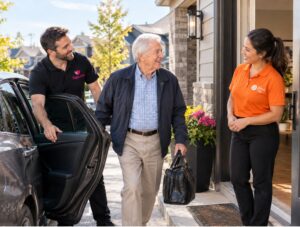
RideSenior, for example, can be relevant to seniors who need transportation for medical appointments, everyday activities, and hospital related transportation.
The goal is not to replace medical professionals.
Instead, transportation connects the senior with the places and people necessary for everyday life.
Hospital Discharge Transportation for Seniors
Hospital discharge is a particularly important transportation situation.
After being released from a hospital, an older adult may need a safe and organized way to return home.
The transportation process can involve more than simply arriving at the hospital entrance.
Depending on the hospital’s discharge procedures and the patient’s circumstances, a transportation provider may offer different pickup models.
One model involves the transportation employee going to the patient’s hospital unit or floor, completing or signing required discharge documentation where appropriate, and escorting the patient from the unit down to the vehicle.
This type of service can be particularly valuable when the hospital requires the patient to be accompanied from the unit before release.
Another model involves meeting the patient at a designated waiting area or lobby.
The exact procedure depends on the hospital, discharge requirements, and service arrangement.
For families, understanding this difference is important when arranging transportation for an older adult returning home.
Why Door Through Door Assistance Can Matter
For a senior leaving a hospital, the distance between the hospital room and the vehicle may be more significant than it sounds.
A patient may be tired after treatment.
They may have mobility limitations.
They may be carrying personal belongings.
They may feel uncertain about navigating a large hospital.
Having a transportation employee meet the patient at the appropriate hospital unit and escort them toward the vehicle can simplify the transition.
This is a transportation and escort function rather than medical treatment.
The transportation employee does not replace a nurse or other healthcare professional.
Instead, the service addresses the practical transportation portion of the journey home.
For Edmonton families arranging a hospital discharge ride, asking whether the provider offers unit or floor pickup versus lobby pickup can therefore be an important practical question.
Creating a Connected Support System for Edmonton Seniors
Independent living rarely depends on one service.
Instead, different forms of support can work together.
Consider an Edmonton senior who lives alone and wants to remain in their own home.
They may use TapLook for senior friendly personal nail care.
They may use BabaTap for grocery shopping, light cleaning, errands, driving, and companionship.
They may use RideSenior when they need transportation to medical appointments or assistance returning home after hospital discharge.
None of these services needs to replace the others.
Each addresses a different practical aspect of daily living.
This creates a more flexible approach to aging at home.
A Typical Day for a Senior Living Independently
Imagine an older adult living in Edmonton who wants to maintain a familiar weekly routine.
On one day, the senior may need groceries.
Instead of depending entirely on a family member’s schedule, the senior could arrange companion assistance for the shopping trip.
Another day might involve a medical appointment.
Specialized senior transportation can help the senior travel to the appointment and return home.
Later in the week, the senior may schedule a personal grooming appointment through a senior focused service such as TapLook.
At home, practical assistance from BabaTap may help with selected household tasks.
The senior remains at the center of the schedule.
The services provide support around the senior’s choices.
This is the basic idea behind aging in place: assistance should make independent living more practical rather than unnecessarily taking control away from the older adult.

Supporting Family Members Without Replacing Them
Adult children often want to help their parents as much as possible.
However, geographical distance and daily responsibilities can make it difficult to provide every ride, errand, shopping trip, and household task personally.
A daughter may live across Edmonton.
A son may work full time.
Another family member may live in another city or province.
Professional non medical support services can help fill some of these practical gaps.
This does not mean that family involvement becomes less important.
Instead, family members can focus on the areas where their presence matters most while trusted services assist with routine activities.
For families researching Senior Home Care options, this distinction can be useful.
The objective is not always to find one provider that does everything.
Sometimes the better approach is to identify individual needs and match each need with the appropriate type of service.
What Makes Senior Support Different?
Supporting an older adult requires more than simply completing a task.
The way assistance is delivered can influence how comfortable the senior feels.
Respect matters.
Choice matters.
Privacy matters.
Consistency matters.
A senior should not feel that receiving help means losing control over their own life.
A companion helping with groceries can still allow the senior to select the products.
A transportation employee can assist with the journey while respecting the senior’s personal space.
A personal care provider can create a senior friendly environment without treating the older adult as incapable.
These small details can contribute to a larger feeling of independence.
The Difference Between Assistance and Dependence
There is a common misconception that accepting assistance automatically means becoming dependent.
In reality, appropriate support can sometimes allow a person to remain independent for longer.
For example, a senior who receives help carrying groceries may continue living at home rather than changing their entire living arrangement.
A senior who receives transportation may continue attending appointments and community activities.
A senior who receives companionship may feel more comfortable completing everyday errands.
A senior who has access to convenient personal care can maintain familiar grooming routines.
The assistance does not necessarily remove independence.
It can remove barriers that make independence harder.
Planning Senior Support Before a Crisis
Families do not always need to wait until a major problem occurs before considering support.
Planning in advance can make transitions easier.
An Edmonton family might begin by identifying the senior’s regular transportation needs.
Then they can consider whether grocery shopping, household assistance, companionship, or personal care support would be useful.
If a hospital admission occurs later, the family already understands which transportation questions need to be asked.
This type of preparation can reduce stress when circumstances change quickly.
It also allows seniors to participate in decisions while they are comfortable and able to express their preferences.
Building an Edmonton Aging at Home Plan
A practical aging at home plan can be organized around several simple questions.
What does the senior currently do independently?
Which activities are becoming difficult?
Which tasks are inconvenient rather than medically necessary?
Which activities does the senior still want to control personally?
Which services could help with transportation?
Which services could provide companionship?
Which personal care activities would benefit from senior friendly support?
Which household tasks could be delegated?
Once these questions are answered, families can create a support network based on actual needs rather than assumptions.
For one senior, transportation may be the biggest priority.
For another, grocery shopping and companionship may matter more.
For another, personal grooming and household assistance may provide the greatest practical benefit.
The right combination can change over time.

Looking at Senior Support as a Continuum
Aging is not a single event.
Needs can gradually change.
A senior may initially require only occasional transportation.
Later, they may appreciate help with grocery shopping.
At another stage, they may want regular companionship or household assistance.
This means senior support should be flexible.
Families can reassess needs periodically rather than assuming that one service level will remain appropriate forever.
TapLook, BabaTap, and RideSenior represent different categories of practical support that can potentially fit into this evolving picture.
Their roles should remain clearly understood.
TapLook can address senior friendly personal nail care.
BabaTap can provide non medical companionship and practical everyday assistance.
RideSenior can address senior transportation, including transportation related to appointments and hospital discharge.
Together, these services illustrate how independent living can be supported through several specialized forms of assistance rather than one all purpose solution.
Continuing the Journey Toward Independent Living
For seniors in Edmonton, living independently at home can remain realistic when everyday barriers are addressed thoughtfully.
The key is not to assume that every older adult needs the same type of care.
Some seniors need medical services.
Others need transportation.
Others benefit from companionship, grocery assistance, household help, or personal care.
Many may need a combination that changes over time.
By separating these needs and choosing appropriate services, families can create a support structure that respects the senior’s preferences while addressing practical challenges.
How TapLook, BabaTap, and RideSenior Can Work Together
Independent living becomes easier to understand when senior support is viewed as a collection of practical services rather than one single category.
An older adult in Edmonton may have different needs on different days.
One day may involve a grocery trip.
Another may involve a medical appointment.
A different day may be spent at home with assistance with light household tasks.
There may also be occasions when the senior wants to maintain personal grooming and enjoy a senior friendly nail care experience.
These activities are not necessarily connected from a medical perspective, but they are connected from the perspective of everyday independence.
TapLook can support personal nail care.
BabaTap can provide practical companionship and everyday assistance.
RideSenior can provide transportation for seniors who need to travel to appointments, everyday destinations, or return home after hospital discharge.
When families understand the distinct role of each service, they can create a more organized approach to supporting an older adult.
The senior can remain involved in deciding what assistance is needed, when it is needed, and how frequently it should be arranged.
Choosing Support Based on the Senior’s Actual Needs
Every senior has a different lifestyle.
Some older adults remain highly active and independent.
Others may have difficulty with specific physical activities while remaining fully capable of managing decisions, finances, schedules, and personal preferences.
This is why support should begin with the question:
What does the senior actually need help with?
If the answer is transportation, a senior transportation service may be appropriate.
If the answer is grocery shopping or companionship, a companion service may be more relevant.
If the issue involves personal nail care, a senior focused personal care provider may be appropriate.
If the need involves clinical treatment, medication management, nursing care, or other healthcare requirements, families should look for qualified healthcare professionals.
Separating these categories helps prevent confusion.
It also allows seniors to receive support without unnecessarily treating everyday activities as medical problems.
When a Senior Needs a Companion Rather Than a Caregiver
The word caregiver is often used broadly, but not every senior who needs help requires a traditional caregiving arrangement.
Consider an older adult who can prepare meals, take medications independently, communicate with healthcare professionals, and manage personal decisions.
However, the senior may no longer feel comfortable driving.
They may dislike shopping alone.
They may need help with light cleaning.
They may appreciate having someone accompany them during errands.
This is a different type of need.
A companion service can address these practical activities while allowing the senior to remain responsible for their own daily choices.
This is where Companion Care for Seniors becomes particularly relevant.
The objective is practical support and companionship rather than medical treatment.
Companionship and Social Connection
Living alone does not automatically mean that a senior is socially isolated.
Many older adults have friends, neighbors, relatives, community groups, and regular activities.
Nevertheless, everyday companionship can still be valuable.
A companion can provide conversation during an errand.
They can accompany a senior while shopping.
They can assist with a trip to a local destination.
They can make an ordinary day feel more connected.
For families living busy lives, this type of support can also provide reassurance.
The family knows that someone is available to assist with selected activities when they cannot personally be there.
Grocery Shopping as an Independence Tool
Grocery shopping is one of the clearest examples of how practical assistance can support aging at home.
A senior may want to choose their own food.
They may have specific dietary preferences.
They may know which products they prefer.
They may enjoy visiting a particular Edmonton grocery store.
The problem may simply be getting there or carrying everything home.
A companion can help with transportation and physical tasks while allowing the senior to remain involved.
This approach supports autonomy.
The senior is not simply being handed groceries selected by someone else.
They can participate in the experience.
That distinction can make assistance feel empowering rather than restrictive.
Helping Seniors Maintain Their Home Environment
A comfortable home is important for aging in place.
As people grow older, household tasks can become tiring even when they remain capable of living independently.
Light cleaning, organizing, and everyday household tasks may require more time and physical energy.
BabaTap’s companion model can be relevant for seniors who need practical non medical assistance with these types of activities.
The purpose is to help make everyday living more manageable.
It is not to provide medical treatment.
Families should still distinguish between ordinary household assistance and specialized healthcare services.
If a senior has a medical condition requiring professional intervention, the appropriate healthcare provider should remain responsible for that aspect of care.
Personal Grooming and Confidence
Personal grooming can have a surprisingly important role in independent living.
An older adult may feel more confident when they can continue their preferred grooming routines.
For some seniors, nail care is part of a regular beauty routine.
For others, it is connected to social events, family gatherings, or simply feeling comfortable with their appearance.
TapLook provides a senior focused environment for nail care and personal grooming.
This can complement other forms of practical support.
For example, if transportation is difficult, a family may arrange transportation separately.
If the senior wants companionship during the outing, that can also be considered.
The services can be organized around the senior’s preferences rather than forcing every need into one category.
Home Care for Seniors: Looking Beyond Medical Services
The phrase Home Care for Seniors can sometimes create confusion because home based support can include many different service types.
A family searching for assistance should examine what each provider actually offers.
Questions may include:
Does the provider offer medical care?
Does the provider offer personal care?
Does the provider offer companionship?
Does the provider provide transportation?
Does the provider assist with groceries?
Does the provider offer household assistance?
Does the provider specialize in senior friendly personal grooming?
Does the provider provide hospital discharge transportation?
The answers can help families determine whether a service matches the senior’s needs.
This is particularly important because a senior may not need comprehensive home healthcare.
They may simply need practical support that makes independent living easier.
Understanding Non Medical Senior Transportation
Transportation is another area where terminology matters.
Non medical senior transportation is designed to help older adults travel safely and conveniently without providing medical treatment during the journey.
This can include rides to:
Medical appointments
Dental appointments
Grocery stores
Pharmacies
Shopping centers
Community activities
Family visits
Personal appointments
Other everyday destinations
The driver or transportation employee is responsible for the transportation service according to the provider’s service model.
Healthcare decisions remain with healthcare professionals.
This separation makes it easier for families to understand what transportation services can and cannot provide.
Hospital Discharge: A More Detailed Look
Hospital discharge transportation deserves special attention because returning home after hospitalization can be more complicated than a normal ride.
A senior may be waiting for discharge paperwork.
The hospital may have specific procedures before allowing the patient to leave.
The patient may need assistance moving from the hospital unit to the vehicle.
This is where the difference between hospital unit pickup and lobby pickup becomes important.
Type 1: Hospital Unit or Floor Pickup
Under a unit or floor pickup model, the transportation employee goes to the patient’s hospital unit.
Where the hospital’s procedures require it, the employee may sign or assist with the relevant discharge documentation according to the transportation arrangement.
The employee then escorts or walks the patient from the unit toward the vehicle.
This can be particularly useful when the hospital requires the patient to be accompanied from the unit before they can leave.
For families, this service model can reduce the logistical burden associated with hospital discharge.
Instead of asking a family member to leave work, travel to the hospital, find the correct floor, complete the pickup process, and escort the patient out, a dedicated transportation employee can handle the transportation portion of the process.
The exact requirements can vary between hospitals.
Families should therefore confirm the discharge procedure with the hospital and transportation provider before the scheduled pickup.
Type 2: Lobby Pickup
A second model involves meeting the patient at a hospital lobby or designated waiting area.
This can work when the hospital releases the patient to the waiting area and the patient is able to reach that location with the hospital’s assistance.
For some seniors, this may be sufficient.
For others, especially after a difficult hospital stay, traveling from the hospital unit to the lobby may present an additional challenge.
This is why families should ask specifically what type of hospital discharge pickup a transportation provider offers.
Why the Pickup Location Matters
A hospital can be a large and unfamiliar environment.
Finding the correct unit, navigating elevators, handling discharge procedures, and reaching the vehicle can take time.
For an older adult who has just completed treatment, these steps may feel overwhelming.
A unit pickup service can simplify the transition.
The transportation employee meets the senior where the discharge process is taking place and assists with the transportation journey toward home.
This does not mean the transportation employee is providing nursing care.
The distinction remains important.
The hospital’s healthcare team handles medical discharge.
The transportation provider handles the transportation and escort component according to the agreed service.
Transportation After Medical Appointments
Hospital discharge is not the only situation in which senior transportation matters.
Older adults often have recurring appointments.
These may include visits to physicians, specialists, dentists, physical therapy providers, imaging centers, or other healthcare destinations.
Driving after an appointment may not always be convenient.
Family schedules may also make it difficult to provide transportation every time.
A senior transportation service can help address this practical issue.
The senior can maintain their appointment schedule while receiving transportation assistance.
This can support continuity in everyday life without requiring the senior to give up independence simply because driving has become more difficult.
Transportation for Everyday Life
Senior transportation should not be viewed exclusively through a medical lens.
Older adults also need to participate in ordinary life.
They may want to visit friends.
They may attend community activities.
They may go shopping.
They may visit a salon.
They may go to a restaurant.
They may attend a family event.
They may simply want to leave the house for a change of scenery.
Reliable transportation can help make these activities more accessible.
This is especially relevant to aging in place because a home is only one part of an independent lifestyle.
Independence also means having reasonable access to the community outside the home.
How Family Members Can Coordinate Services
Family members can make senior support easier by coordinating services around the older adult’s routine.
For example, a family might identify three categories:
Transportation needs
Household and companionship needs
Personal grooming needs
The first category could involve RideSenior.
The second could involve BabaTap.
The third could involve TapLook.
This structure makes it easier to understand which provider should be contacted for each situation.
It also avoids expecting one service to perform tasks outside its role.
Questions Families Should Ask Before Booking
Before arranging any senior service in Edmonton, families should ask clear questions.
For companion services, they may ask:
What types of everyday activities can the companion assist with?
Does the service include grocery shopping?
Does it include light household assistance?
Can the companion accompany the senior on errands?
Is the service medical or non medical?
For personal care, families may ask:
Is the service specifically designed for seniors?
What personal care services are offered?
Is the environment senior friendly?
For transportation, questions may include:
Does the service provide transportation for medical appointments?
Does it provide everyday rides?
How does hospital discharge transportation work?
Does the employee meet the patient at the hospital unit?
Can the employee escort the patient from the unit to the vehicle?
Does the provider also offer lobby pickup?
What information does the hospital require?
These questions can prevent misunderstandings and help families select services according to actual requirements.
Respecting Senior Choice
One of the most important principles of independent living is allowing seniors to remain involved in decisions.
Family members may sometimes focus entirely on safety.
Safety is important, but independence and personal choice also matter.
An older adult may want to choose their own grocery store.
They may want to decide when to schedule nail care.
They may prefer one transportation arrangement over another.
They may want companionship but not constant supervision.
They may want household assistance only once a week.
A good support plan should make room for these preferences.
The senior should remain an active participant whenever possible.
Preserving Dignity Through Practical Support
Dignity is closely connected to how assistance is delivered.
A senior may accept help more comfortably when the service feels like an extension of their independence rather than a replacement for it.
For example, helping a senior shop does not require taking over the entire shopping process.
Driving a senior does not mean making decisions about where they should go.
Providing companionship does not mean treating the senior as incapable of making their own choices.
Supporting personal grooming does not mean assuming that appearance is unimportant.
These distinctions may seem small, but they influence how older adults experience support.
A Flexible Approach to Aging at Home in Edmonton
Aging at home does not have to mean doing everything alone.
It can mean creating an environment in which the senior has access to the assistance necessary to continue living comfortably.
For one Edmonton senior, transportation may be the biggest challenge.
For another, grocery shopping may be the main concern.
For another, companionship may be valuable.
Someone else may want assistance maintaining personal grooming.
Needs can also change.
A person who needs only occasional transportation today may need additional practical assistance in the future.
A flexible support system can adapt as those needs develop.
Combining Services Without Losing Independence
The combination of TapLook, BabaTap, and RideSenior illustrates a broader concept of senior support.
Different services can address different barriers.
TapLook can support senior personal nail care and grooming.
BabaTap can assist with practical non medical activities such as companionship, grocery shopping, driving, and light household tasks.
RideSenior can help seniors travel to medical appointments, everyday destinations, and home after hospital discharge.
The senior remains at the center of this arrangement.
The purpose of the services is to make daily activities more accessible.
They do not have to mean surrendering control.
Instead, the right assistance can help an older adult continue making decisions and participating in the routines that matter to them.
When Professional Healthcare Is Needed
It is equally important to recognize the limits of non medical support.
Some situations require qualified healthcare professionals.
Medical treatment, nursing care, medication administration, clinical monitoring, rehabilitation, and other healthcare needs should be handled by appropriate professionals.
TapLook and BabaTap should not be viewed as substitutes for medical care.
Likewise, a transportation employee should not be considered a medical provider simply because the transportation service involves a hospital or medical appointment.
Keeping these roles clear protects seniors and helps families make informed arrangements.
Creating a Practical Senior Support Checklist
Families in Edmonton can use a simple checklist when planning support for an older adult.
Start by identifying the senior’s current abilities.
Next, identify activities that have become difficult.
Then separate medical needs from practical needs.
After that, consider transportation.
Ask whether the senior needs regular rides, occasional rides, or hospital discharge transportation.
Consider companionship.
Determine whether the senior would benefit from assistance with shopping, errands, household activities, or social outings.
Consider personal care.
Ask whether senior friendly nail care or grooming services would improve the senior’s routine.
Finally, review the plan regularly.
Needs can change, and the support arrangement should be adjusted accordingly.
A More Sustainable Approach for Families
Family caregivers often want to do everything themselves.
However, providing every ride, shopping trip, household task, and appointment escort may not always be sustainable.
Using specialized services can distribute some of the practical responsibilities.
This can allow family members to remain closely involved without becoming the only source of everyday support.
A daughter can still call her parent every morning.
A son can still visit on weekends.
Grandchildren can still spend meaningful time with their grandparent.
Meanwhile, a companion can help with an errand, a transportation provider can handle a scheduled ride, and a senior focused personal care service can support grooming.
The result is a support network rather than a single point of dependence.
The Bigger Picture of Senior Independence
Independent living is not defined by the absence of assistance.
It is better understood through the senior’s ability to participate in decisions and maintain meaningful control over daily life.
Practical services can remove obstacles.
Transportation can remove the barrier of driving.
Companionship can make errands easier.
Grocery assistance can reduce physical strain.
Light household assistance can make home maintenance more manageable.
Personal grooming services can help maintain familiar routines.
Hospital discharge transportation can simplify the journey from hospital to home.
Each service addresses a different challenge.
Together, they can contribute to an environment in which an Edmonton senior has more opportunities to remain active and comfortable at home.
Final Thoughts
The question of how to help seniors remain independent at home does not have one universal answer.
Every older adult has a different lifestyle, different abilities, and different priorities.
For seniors in Edmonton, practical non medical services can form an important part of an aging at home strategy.
TapLook can contribute through senior focused nail care and personal grooming.
BabaTap can provide companionship and everyday practical assistance such as grocery shopping, driving, light cleaning, and errands.
RideSenior can support transportation needs, including medical appointments, everyday rides, and hospital discharge transportation.
For hospital discharge, families should understand whether the transportation provider offers unit or floor pickup, where an employee goes to the patient’s hospital unit and escorts the patient toward the vehicle, or lobby pickup, where the senior is met at a designated waiting area. The appropriate arrangement depends on the hospital’s procedures and the senior’s circumstances.
At the same time, families should distinguish non medical support from professional healthcare. Home Care for Seniors can describe a broad range of services, while individual providers may specialize in very different forms of assistance.
For seniors who primarily need everyday support and social connection, Companion Care for Seniors can provide a practical alternative to assuming that every need requires medical care.
The central idea is simple: seniors should have access to the assistance they need while retaining as much choice and control as possible.
With thoughtful planning, families can combine transportation, companionship, household assistance, and personal care services around the senior’s existing lifestyle.
For an older adult who wants to remain in their Edmonton home, that kind of coordinated support can make everyday independence more practical, comfortable, and sustainable.