
How TapLook and BabaTap Help Seniors Live Independently at Home in Red Deer. For many older adults, remaining at home is about more than having a familiar place to live. It is about preserving independence, maintaining daily routines, staying connected with family and community, and continuing to make personal choices with confidence. In Red Deer, seniors and their families may need a combination of practical transportation, personal assistance, beauty and grooming support, household help, companionship, and reliable assistance after a hospital stay. This is where services associated with TapLook and BabaTap can complement broader senior support resources. When families search for Senior Home Care, Home Care for Seniors, Companion Care for Seniors, senior transportation, elderly assistance at home, or non-medical support for older adults, they are often looking for practical solutions that help a loved one continue living safely and comfortably in a familiar environment. TapLook can support seniors through convenient mobile beauty and personal care services, while BabaTap focuses on everyday companionship and practical assistance such as transportation, grocery shopping, household help, and spending time with seniors. Together, these services illustrate how non-medical support can contribute to an independent lifestyle. For families coordinating care following a hospital discharge, transportation is another important part of the transition home. A discharge transportation provider may need to go directly to the hospital ward or floor, complete required discharge procedures with the patient or hospital team, and escort the senior safely from the ward to the vehicle before taking them home. In some situations, transportation may instead begin at the hospital lobby. Understanding these differences helps families plan a smoother return home while arranging the ongoing support a senior may need after arriving at their residence.

Why Independent Living Matters for Seniors in Red Deer
Independent living can mean different things to different older adults.
For one senior, independence may mean preparing breakfast in their own kitchen every morning. For another, it may mean continuing to live with a beloved pet, choosing when to go shopping, maintaining a personal grooming routine, or visiting friends without depending on family members for every small task.
These everyday decisions can have significant emotional value.
Aging does not automatically mean that a person wants to leave their home or surrender control over their daily schedule. Many older adults prefer to remain in the community they know, surrounded by familiar belongings, neighbors, routines, and memories.
However, remaining at home can become more challenging when transportation is difficult, household tasks take longer, or family members cannot always be available.
This is where non-medical senior support can become valuable.
Services focused on companionship, errands, transportation, household assistance, personal grooming, and everyday activities can help address practical barriers without changing the senior’s role as the decision-maker in their own life.
Understanding Senior Home Care in the Context of Independence
The phrase Senior Home Care can describe a wide range of support, depending on the provider and the needs of the individual.
Families may use the term when searching for assistance with everyday living, companionship, transportation, household responsibilities, personal routines, or other forms of non-medical help.
It is important, however, to understand the difference between companion or lifestyle assistance and professional medical care.
A senior may need help getting groceries without needing nursing services. They may appreciate someone accompanying them to an appointment without requiring medical treatment. They may want assistance with light household tasks, transportation, or simply having someone nearby for conversation.
These needs are still meaningful.
BabaTap is positioned around senior companionship and practical everyday assistance rather than medical treatment. This distinction matters because families should select support based on the actual needs of their loved one.
A senior who wants to remain at home may benefit from several different types of support working together.
For example, a family might arrange:
- Transportation after a hospital discharge
- Grocery shopping assistance
- Household help
- Companionship during several hours of the day
- Transportation to social activities
- Mobile beauty services
- Assistance maintaining familiar personal routines
Each service addresses a different part of independent living.
How BabaTap Supports Everyday Senior Life
BabaTap focuses on companionship and practical assistance for seniors.
The concept is straightforward. Older adults do not always need intensive care. Sometimes they simply need another person to help with everyday activities that have become inconvenient or difficult to manage alone.
That support can make a meaningful difference.
Transportation for Seniors
Driving can become less convenient for some older adults because of changes in mobility, confidence, vehicle access, or family availability.
BabaTap can provide practical transportation assistance for everyday activities such as shopping, visiting friends, attending appointments, or completing errands.
Transportation is particularly important because mobility and independence are closely connected.
When a senior cannot easily leave home, ordinary activities can become more complicated. A grocery trip may require coordinating with an adult child. A social visit may be postponed. An appointment may require someone to take time away from work.
Reliable assistance can reduce some of these logistical challenges.
Grocery Shopping Assistance
Grocery shopping is another everyday responsibility that can become difficult with age.
The issue is not necessarily the ability to choose food. A senior may still enjoy selecting their own groceries but have difficulty driving to the store, carrying bags, or completing the entire trip.
Companion assistance can help preserve participation.
Instead of removing the senior from the process, support can allow them to remain involved in decisions about what they want to buy.
That distinction is important for independence.
Household Assistance
A clean and organized home can contribute to comfort and confidence.
However, some household activities can become physically demanding.
Light cleaning, organizing, tidying, and other everyday tasks may take more energy than they once did.
BabaTap’s companion-oriented model can help families address practical household needs while allowing seniors to remain in their own homes.
The objective is not to take over every responsibility.
Instead, appropriate assistance can help make daily life more manageable.
Home Care for Seniors and the Value of Companionship
Home Care for Seniors is often discussed in terms of practical assistance, but companionship deserves equal attention.
Loneliness and reduced social interaction can affect how enjoyable everyday life feels, particularly when an older adult spends long periods alone.
Companionship can be as simple as having someone to talk with, sharing a meal, going for a walk, visiting a local destination, or accompanying a senior while they complete an errand.
These activities can help maintain a sense of normality.
A companion can also provide encouragement to participate in ordinary activities rather than spending every day at home alone.
For families, companionship can provide reassurance that their loved one has regular human interaction when relatives cannot be physically present.
Personal Grooming and Confidence at Home
Personal appearance can remain an important part of senior wellbeing and self-expression.
For many older adults, having their nails cared for, receiving beauty services, or maintaining a familiar grooming routine is not simply cosmetic.
It can be connected to confidence, dignity, social participation, and feeling like oneself.
This is an area where TapLook’s mobile service model can complement other forms of senior support.
Rather than requiring a senior to travel to a salon or spa, mobile beauty services can bring selected personal care experiences closer to the senior’s home.
This can be particularly useful for older adults who find transportation difficult.
A familiar grooming routine can also help seniors prepare for birthdays, family gatherings, community events, holidays, or ordinary social activities.
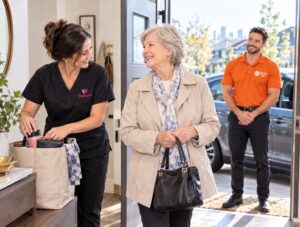
Why Mobile Services Can Be Helpful for Older Adults
Leaving home can require more planning as people age.
A senior may need transportation, assistance getting ready, someone to accompany them, and help returning home.
For a relatively simple service, this can become a significant logistical process.
Mobile services approach the problem differently by bringing the service to the client.
For seniors, this can mean fewer transportation arrangements and less time spent traveling.
For family members, it can mean fewer tasks to coordinate.
The result is a support structure that fits more naturally into the senior’s existing routine.
Connecting Transportation With Independent Living
Transportation is one of the most important links between home and the wider community.
A senior may live independently but still need transportation support to access the activities that make independent living meaningful.
Consider a senior who lives at home in Red Deer.
They may want to:
- Attend a medical appointment
- Pick up groceries
- Visit a family member
- Attend a community event
- Go shopping
- Visit a friend
- Complete personal errands
- Return home after a hospital stay
Without transportation, each activity can become more difficult.
This is why senior transportation should not be viewed only as getting from one address to another.
It can be part of maintaining community participation and daily independence.
Hospital Discharge Transportation and the Journey Home
Hospital discharge represents a particularly important transportation situation.
When a patient is ready to leave a hospital, getting them home is not always as simple as arranging a vehicle at the entrance.
For many discharge situations, the transportation provider needs to go directly to the patient’s hospital ward or floor.
This is the first service model families should understand.
The provider arrives at the hospital, goes to the appropriate ward, coordinates the discharge process as required, signs or assists with required documentation where appropriate, and escorts the patient from the ward to the vehicle.
The escort component is especially important for seniors who may have limited mobility or who should not be expected to navigate the hospital independently immediately before returning home.
In the second model, the transportation provider meets the patient at a hospital lobby or designated waiting area.
Lobby pickup can be appropriate in certain situations, particularly when hospital procedures allow the patient to leave the ward independently and meet the driver downstairs.
However, families should not assume that lobby pickup is sufficient for every discharge.
The exact requirements depend on the hospital, the patient’s circumstances, and the discharge process.
For seniors who need assistance leaving the ward, an escort-based discharge transportation service can provide a more comprehensive transition from hospital to vehicle.
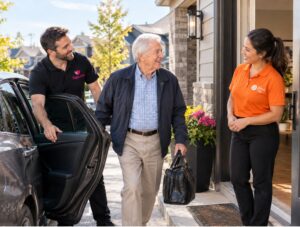
Why the Ward-to-Vehicle Escort Matters
Imagine an older adult who has just received hospital treatment.
Even when the patient is medically cleared to leave, they may feel tired, unfamiliar with the hospital layout, or uncertain about navigating elevators, corridors, entrances, and waiting areas.
A family member may not be able to arrive immediately.
A discharge transportation provider who comes to the ward can help bridge this gap.
The process may involve meeting the patient on the appropriate floor, coordinating with hospital staff, assisting with belongings, accompanying the senior through the hospital, and helping them reach the waiting vehicle.
The provider then transports the senior home.
This is different from a conventional ride that simply begins at a curb or lobby.
The distinction becomes especially relevant when families are searching for non-medical hospital discharge transportation services for an older adult.
Returning Home Is Only the Beginning
A successful discharge does not end when the vehicle reaches the driveway.
The senior may still need practical assistance after arriving home.
They may need groceries, household help, companionship, transportation to future appointments, or assistance returning to normal routines.
This is where the broader network of non-medical support becomes important.
A family may coordinate discharge transportation first and then arrange companion assistance for subsequent days.
For example, a senior returning home after hospitalization might need:
• Transportation from the hospital ward to home
• Grocery shopping assistance
• Light household support
• Companionship
• Transportation to follow-up appointments
• Mobile personal grooming services
• Assistance with everyday errands
Each service can address a different practical need.
The goal is to create continuity between the hospital, transportation, home, and community.
Creating a Practical Support Network for Seniors
No single service needs to provide everything.
Independent living often works best when families understand which type of assistance is appropriate for each situation.
TapLook can contribute mobile personal care and beauty services.
BabaTap can contribute companionship and practical everyday assistance.
Senior transportation providers can help with travel and hospital discharge transitions.
Healthcare professionals remain responsible for medical needs.
Family members can continue providing emotional support, decision-making assistance, and oversight when appropriate.
Together, these resources can form a practical support network that respects the senior’s independence.
The most important principle is that assistance should support the older adult’s lifestyle rather than unnecessarily replace it.
Independence Does Not Mean Doing Everything Alone
One common misunderstanding about independent living is that a senior must handle every task without assistance.
That is not necessarily what independence means.
A person can remain independent while receiving help.
A senior who receives transportation assistance can still choose where to go.
A senior who receives grocery assistance can still decide what to purchase.
A senior who receives companionship can still determine how they spend their time.
A senior who receives mobile beauty services can still choose their preferred style and routine.
Independence can therefore be understood as maintaining control over personal decisions while receiving appropriate support for tasks that have become more difficult.
This approach can help families provide assistance without making an older adult feel that they have lost control of their life.
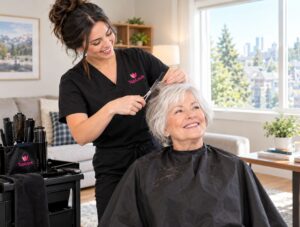
Building a Sustainable Routine After Returning Home
The transition from hospital to home can be easier when families think beyond the first ride.
A senior may arrive home safely but still need help adjusting to everyday routines. Transportation, shopping, household responsibilities, social activities, and personal routines can all require additional planning.
This is where a coordinated approach to Senior Home Care can be useful.
Rather than treating every need as one large caregiving responsibility, families can identify individual tasks and determine which type of support is appropriate for each one.
For example, transportation may be arranged for appointments, while a companion service helps with errands and household activities. Mobile beauty services can address personal grooming without requiring an additional trip outside the home.
This approach allows seniors to receive practical assistance while continuing to participate in their own routines.
Supporting Seniors With Everyday Errands
Small errands can become surprisingly important to independent living.
Picking up groceries, visiting a pharmacy, collecting household supplies, returning an item, or going to a local shop can give seniors opportunities to remain active in their communities.
When transportation becomes difficult, these ordinary activities may gradually disappear from a person’s routine.
Companion assistance can help restore some of that flexibility.
A senior may still decide where they want to go and what they want to accomplish. The companion simply provides the practical support needed to make the activity possible.
This is one reason Companion Care for Seniors can be different from traditional concepts of intensive caregiving.
The emphasis can be on participation rather than replacing the senior’s role.
Companion Care for Seniors and Social Connection
Companion Care for Seniors can also provide an important social dimension to independent living.
An older adult may have family members who care deeply about them but live elsewhere or have demanding work and family schedules.
Regular companionship can help fill some of the practical gaps created by distance and busy schedules.
Companionship might include conversation, accompanying a senior on an outing, helping with shopping, going for a walk, watching a favorite program together, or simply spending several hours together.
These activities do not need to be complicated.
Consistency can be more important than complexity.
A familiar companion who understands the senior’s preferences and routines can make everyday assistance feel more natural.
Helping Seniors Stay Connected With Their Community
Living independently does not mean staying inside the home.
Community participation can be an important part of a fulfilling lifestyle.
A senior may enjoy attending local events, visiting friends, going to a community center, meeting family members for lunch, or participating in hobbies.
Transportation and companionship can make these activities more accessible.
Without reliable transportation, social activities can become increasingly dependent on family availability.
With appropriate assistance, seniors may have more opportunities to maintain their existing interests.
This can be particularly valuable after a hospital stay, when an older adult may temporarily reduce their normal activities.
A gradual return to familiar routines can help make the transition home feel less disruptive.
How TapLook Fits Into a Broader Senior Support Routine
TapLook’s role is different from that of a medical provider or traditional home health agency.
Its mobile beauty and personal care services can bring grooming-related services directly to clients.
For older adults, this can remove one practical barrier: transportation to a salon.
A senior who enjoys regular nail care or beauty services may otherwise need to coordinate a ride, prepare for an outing, travel to the salon, complete the appointment, and arrange transportation home.
A mobile service simplifies that process by bringing the service closer to the client.
This can be particularly convenient for seniors who prefer familiar surroundings.
Personal grooming can also remain part of a senior’s identity.
Maintaining a preferred appearance can support confidence and encourage participation in social activities.
How BabaTap Can Complement Transportation Services
BabaTap and senior transportation services can address different stages of the same journey.
Transportation focuses on moving the senior from one location to another.
Companion support can address what happens around that trip.
Consider a senior who needs to visit a grocery store.
Transportation may provide the ride.
A companion may also assist with shopping, carrying items, organizing the trip, or accompanying the senior through the activity.
Similarly, a senior returning from a hospital may need specialized discharge transportation to get home safely, followed by practical assistance during the following days.
This creates a useful distinction:
Transportation helps a senior get somewhere.
Companionship can help a senior participate once they get there.
Both can have a place in an independent-living plan.
Planning for Hospital Discharge Before the Day of Discharge
Families should ideally think about transportation before discharge day.
Hospital discharge can happen on a schedule that changes depending on medical clearance, paperwork, prescriptions, instructions, and other hospital processes.
For seniors, additional planning may be necessary.
Families can ask:
• Does the transportation provider go directly to the hospital ward?
• Can the provider escort the patient from the ward to the vehicle?
• Is lobby pickup available if the hospital permits it?
• Can the vehicle accommodate the senior’s mobility requirements?
• Will the provider assist with belongings?
• What information does the transportation company need in advance?
• Where should the family member meet the senior?
• What happens if discharge timing changes?
These questions help reduce confusion.
The most important distinction is whether the service provides ward-level pickup or expects the patient to reach the lobby independently.
For many hospital discharge situations, ward-level assistance is particularly relevant because the patient may need someone to come to the hospital floor before leaving.
The Difference Between Medical and Non-Medical Transportation
Non-medical hospital discharge transportation should not be confused with ambulance transportation or clinical patient transport.
A non-medical transportation provider generally focuses on transportation, assistance, and escorting rather than medical treatment.
This distinction is important when families are selecting a service.
If a patient requires medical monitoring, clinical intervention, specialized medical equipment, or emergency transportation, the appropriate medical service should be used.
If the patient is cleared to leave but needs practical assistance getting from the hospital ward to home, non-medical discharge transportation may be relevant.
Families should always follow the hospital’s discharge instructions and ask healthcare professionals about transportation requirements when circumstances are unclear.
Making the Home Environment Easier to Manage
Once the senior arrives home, the physical environment becomes another important consideration.
A senior may feel comfortable in a familiar house but find certain everyday tasks more difficult after a hospital stay.
Frequently used items should be easy to reach.
Walking paths should remain clear.
Important household supplies should be available.
Food and groceries should be organized.
Transportation arrangements for upcoming appointments should be confirmed.
Family members can also create a simple schedule showing who is available and when.
These practical steps do not necessarily require intensive care.
Sometimes the difference between a difficult week and a manageable week is simply having the right support at the right time.

Coordinating Family Members With Outside Support
Family involvement remains important even when outside services are used.
Adult children and relatives may want to remain involved but cannot necessarily perform every task themselves.
A coordinated approach can divide responsibilities.
For example, one family member may handle appointments and communication with healthcare providers.
Another may organize transportation.
A companion service may assist with errands.
A mobile beauty provider may handle grooming appointments at home.
This division can reduce the pressure on any single family member.
It can also help seniors maintain relationships with relatives without making every family interaction revolve around caregiving tasks.
Home Care for Seniors Should Reflect Individual Needs
Home Care for Seniors should never be treated as a one-size-fits-all concept.
Two seniors of the same age may have completely different lifestyles.
One may be highly active and only need occasional transportation.
Another may prefer spending more time at home and benefit from regular companionship.
One senior may enjoy cooking and shopping independently but need assistance with transportation.
Another may want help with household tasks but remain fully capable of making personal decisions.
The appropriate support plan should therefore begin with the person’s actual routine.
Ask what the senior wants to continue doing.
Ask which activities have become difficult.
Ask what assistance feels comfortable.
Then identify services that address those specific needs.
Supporting Dignity Through Choice
Dignity is closely connected with personal choice.
An older adult may accept assistance more comfortably when they remain involved in decisions about how that assistance is provided.
For example, instead of deciding that someone should handle all grocery shopping, a family can ask whether the senior wants to go to the store with a companion.
Instead of scheduling beauty services without discussion, the family can ask whether the senior wants to continue their regular grooming routine.
Instead of assuming a family member must provide every ride, the family can explore professional transportation options.
These small decisions can preserve a sense of control.
The objective is not simply to make life easier.
It is to make life easier while respecting the senior’s preferences.
A Practical Example of Independent Living Support
Consider a hypothetical Red Deer senior returning home after a hospital stay.
The patient has been discharged and does not require an ambulance but should not navigate the hospital alone.
A non-medical discharge transportation provider is arranged in advance.
The provider arrives at the hospital, goes to the appropriate ward, coordinates the pickup process, escorts the senior from the ward through the hospital, and assists them into the vehicle.
The senior is then transported home.
After returning home, the family realizes that the senior will need groceries and some practical assistance during the following week.
Rather than asking one family member to handle everything, the family arranges companion assistance for shopping and everyday errands.
A few days later, the senior wants to maintain their regular personal grooming routine.
A mobile beauty service can come to the home, reducing the need for another transportation arrangement.
This example illustrates how several specialized services can work alongside one another.
No single provider has to perform every role.
Each service addresses a specific part of the senior’s daily life.
Transportation, Companionship, and Personal Care Work Together
Independent living can involve several interconnected needs.
Transportation supports mobility.
Companionship supports participation and social connection.
Household assistance supports the practical home environment.
Mobile beauty services support grooming and personal routines.
Family involvement supports relationships and continuity.
Healthcare professionals support medical needs.
When these roles are clearly understood, families can create a more organized support structure.
This can be especially valuable for seniors transitioning home after hospitalization.
When Families Should Consider Additional Support
There are several signs that a senior may benefit from additional practical assistance.
Family members may notice that errands are frequently postponed.
The senior may stop attending activities they previously enjoyed.
Transportation may become a recurring problem.
Household responsibilities may accumulate.
The senior may spend increasingly long periods alone.
Personal grooming routines may become difficult to maintain.
Family members may also find themselves constantly rearranging work schedules to provide transportation and errands.
These situations do not automatically mean that a senior can no longer live independently.
They may simply indicate that additional support could make independent living more sustainable.
Choosing Support Based on the Task
A useful approach is to match each need with the appropriate type of provider.
For medical needs, consult qualified healthcare professionals.
For emergency transportation, use the appropriate emergency service.
For hospital discharge assistance, look for a provider that clearly explains whether it offers ward-level escort service or lobby pickup.
For everyday companionship and errands, a senior companion service such as BabaTap may be relevant.
For mobile beauty and grooming, TapLook can provide an at-home alternative to traditional salon visits.
For family transportation needs, a dedicated senior transportation provider may offer additional options.
This task-based approach helps avoid confusion between different categories of support.
Questions Families Can Ask Before Booking
Before arranging a service, families can ask practical questions.
For Companion Services
Does the service provide companionship and everyday assistance?
Can companions help with errands or grocery shopping?
Can they provide transportation?
What types of household assistance are available?
How are schedules arranged?
For Mobile Beauty Services
Does the provider travel to the senior’s home?
Which grooming or beauty services are offered?
How is the appointment scheduled?
Does the service accommodate the senior’s preferred routine?
For Hospital Discharge Transportation
Does the provider go directly to the patient’s hospital ward?
Will someone escort the senior from the ward to the vehicle?
Is lobby pickup also available?
Does the service handle non-medical transportation only?
What mobility requirements can the vehicle accommodate?
How much advance notice is recommended?
These questions can help families understand exactly what they are booking.
Why a Combination of Services Can Make Home Living More Practical
Independent living is rarely dependent on one service.
It is usually the result of many small supports working together.
A senior may have transportation for appointments, companionship for errands, household assistance when needed, and mobile personal care at home.
Each service can remove a different obstacle.
The senior remains in their familiar environment while receiving assistance where it is genuinely useful.
This model can also change over time.
A senior may need very little support during one period and more assistance after an illness, hospitalization, injury, or major life change.
Families can reassess the situation rather than assuming that today’s needs will remain the same permanently.
Looking Beyond the Hospital Discharge
Hospital discharge is an important milestone, but it should be viewed as one stage in the overall transition.
The real goal is a safe and sustainable return to everyday life.
That means thinking about what happens after the vehicle leaves the hospital.
Who will help with groceries?
Who can provide transportation to follow-up appointments?
Who can spend time with the senior?
Who can help with everyday errands?
How will the senior maintain personal routines?
How will family members remain involved without becoming overwhelmed?
Answering these questions in advance can make the transition more organized.
TapLook, BabaTap, and the Broader Independent Living Picture
The value of services such as TapLook and BabaTap lies in the practical problems they can help address.
TapLook’s mobile beauty model can bring personal grooming services closer to seniors.
BabaTap’s companion-focused model can help with everyday activities such as transportation, grocery shopping, household assistance, and companionship.
Neither should be understood as a replacement for medical care.
Instead, they can occupy a complementary role within a broader network of senior support.
For a senior living independently in Red Deer, that network may also include family members, healthcare providers, transportation companies, community organizations, and other professional services.
The important consideration is how each resource fits the senior’s individual needs.
A More Flexible Vision of Aging at Home
Aging at home does not have to mean refusing assistance.
It can mean choosing assistance that allows a person to continue living according to their preferences.
A senior may want to remain in their own home.
They may want to continue shopping at their favorite stores.
They may want to see friends and family.
They may want to maintain their grooming routine.
They may want to attend appointments without relying entirely on relatives.
They may simply want someone to talk with during the day.
These are ordinary goals, but practical barriers can make them difficult.
Appropriate non-medical services can help reduce those barriers.
Conclusion: Supporting Independence Through Practical Assistance
How TapLook and BabaTap Help Seniors Live Independently at Home in Red Deer is ultimately a story about practical support rather than replacing independence.
Seniors can continue making their own choices while receiving assistance with the activities that have become more challenging.
BabaTap can provide companionship and practical everyday support, including assistance with transportation, grocery shopping, household tasks, and social activities.
TapLook can bring mobile beauty and personal grooming services closer to seniors, helping them maintain familiar routines without always needing to travel to a salon.
Senior transportation services can address another essential part of independent living, particularly when an older adult needs to return home after a hospital stay.
For hospital discharge, families should understand the distinction between ward-level escort and lobby pickup. When the hospital requires someone to come to the patient’s ward before discharge, a provider that goes directly to the hospital floor, completes the appropriate pickup process, and escorts the senior from the ward to the vehicle can provide a more suitable form of assistance than a service that only waits at the lobby.
Once the senior arrives home, the support journey continues.
Companionship, errands, household assistance, transportation, and mobile personal care can all contribute to a practical routine that allows an older adult to remain connected with their home and community.
Home Care for Seniors should therefore be viewed according to the person’s actual needs rather than as a single standardized service.
For some seniors, occasional assistance may be enough.
For others, a combination of transportation, companionship, household support, and mobile personal care may provide the flexibility needed to remain comfortably at home.
The central idea is simple: receiving help does not necessarily reduce independence. When support is respectful, practical, and aligned with personal preferences, it can help seniors continue making choices, maintaining routines, and participating in everyday life.
For families in Red Deer, understanding the difference between medical care, companion assistance, mobile personal services, and senior transportation can make it easier to build an appropriate support network.
A successful transition home is not only about getting a senior from the hospital to their front door.
It is about helping them continue life after they arrive.
Bài viết liên quan: