
How TapLook and BabaTap Help Seniors Live Independently at Home in Saint John. Growing older does not necessarily mean giving up the comfort, privacy, and familiarity of home. For many older adults in Saint John, New Brunswick, staying at home is an important part of maintaining independence and continuing familiar daily routines. At the same time, seniors may gradually need additional help with transportation, errands, household tasks, personal grooming, social activities, or simply having someone nearby for practical support. This is where the right combination of Senior Home Care, in-home assistance, mobile beauty services, and companionship can make everyday life easier.
When families search for Home Care for Seniors in Saint John, they may be looking for very different types of support. Some seniors need personal care or publicly funded home support, while others mainly need transportation, grocery shopping, light household assistance, companionship, or help maintaining their regular lifestyle. New Brunswick recognizes a range of in-home support options designed to help older adults remain as independent as possible, including assistance with everyday activities and household tasks.
For seniors who do not require medical treatment but would benefit from practical assistance, BabaTap can represent a complementary form of senior support. BabaTap focuses on everyday companionship and assistance such as transportation, shopping, errands, household help, and social engagement. TapLook adds another dimension by making beauty and personal grooming services more accessible at home, helping seniors maintain familiar self-care routines without the inconvenience of travelling to a salon.
Together, these services illustrate an important principle of aging at home: independence does not have to mean doing everything alone. With appropriate support, an older adult can continue making personal choices, staying connected with the community, attending appointments, managing errands, enjoying grooming routines, and remaining in a familiar home environment.

Understanding Independent Living for Seniors in Saint John
Independent living is often misunderstood as complete self-sufficiency. In reality, an older adult can live independently while receiving assistance with selected activities.
A senior may still decide what to eat, when to wake up, which friends to visit, what appointments to attend, and how to spend the day. However, certain tasks may become more difficult with age.
Driving may become less convenient.
Grocery shopping may require more physical effort.
Household maintenance may take longer.
Getting to an appointment may require assistance.
A visit to a salon may become inconvenient because of transportation or mobility limitations.
Social isolation may also become a concern when friends or family members are not available every day.
The objective of supportive services is therefore not necessarily to take control of a senior’s routine. Instead, assistance can be organized around the areas where additional help is useful.
This approach is particularly relevant in Saint John, where the local senior-support network includes community organizations, home support providers, transportation programs, companionship services, and government-supported programs. The Human Development Council maintains a Seniors’ Directory for Saint John and also points residents toward 211 New Brunswick for help navigating community services.
New Brunswick’s Social Development information also confirms that in-home services can help older adults remain independent at home. Depending on individual needs and eligibility, services may include personal care, light housekeeping, meal preparation, and caregiver relief.
This broader support environment creates room for specialized non-medical services to address everyday needs that may not require clinical care.
What Senior Home Care Can Mean for an Aging Parent
The phrase Senior Home Care can describe several different types of assistance, and families should understand these differences before arranging support.
Some home care programs provide personal care or health-related services. Others focus on household support, meals, transportation, companionship, or assistance with daily routines.
In Saint John, 211 New Brunswick lists multiple home support resources. For example, local services may include light housekeeping, meal preparation, medication reminders, errands, companionship, personal care, or nursing depending on the provider.
Government-supported programs also distinguish between different forms of care. New Brunswick’s Long Term Care Program includes home support services for daily activities, meal assistance, light housekeeping, and other supports, while other services address nursing and health-related needs.
This distinction matters because not every senior who wants to remain at home needs medical care.
An older adult might simply say:
“I can do most things myself, but I need someone to help with groceries.”
Or:
“I still want to live in my own house, but I do not want to drive across town for every appointment.”
Another senior may want help keeping the home organized or simply appreciate having someone accompany them on an outing.
These needs are real even when they do not require a medical professional.
That is where practical senior assistance and companionship can complement traditional home care.
How BabaTap Supports Everyday Independence
BabaTap is positioned around practical assistance for seniors who want to continue living at home while receiving help with selected everyday activities.
Its Saint John content specifically addresses searches for hourly support for aging parents, including transportation, grocery shopping, errands, household help, and companionship.
The concept is straightforward.
Instead of assuming that a senior needs full-time assistance, support can be organized around specific tasks and time periods.
For example, a senior may need someone for a few hours to:
• Pick up groceries
• Attend an appointment
• Run an important errand
• Help with light household tasks
• Accompany them on a social outing
• Provide friendly company
• Assist with transportation
This type of support can be especially useful for families whose parents are still capable of managing most aspects of daily life.
A daughter or son may live in another city.
A spouse may also be an older adult and have limited ability to handle every errand.
Neighbours may be helpful but cannot always be available.
Professional assistance can fill some of these practical gaps without automatically changing the senior’s living arrangement.
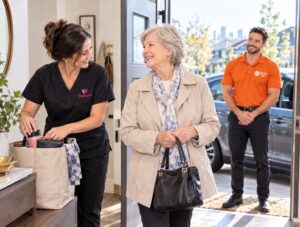
Companion Care for Seniors and the Value of Human Connection
Companionship is more than having another person physically present.
For an older adult, a companion may provide conversation, encouragement, assistance during an outing, and a sense of connection with the outside world.
A simple trip to the grocery store can become an opportunity to leave the house and interact with the community.
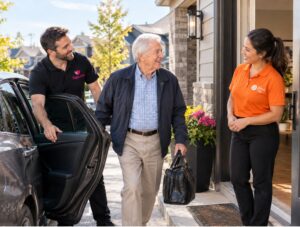
A ride to an appointment can remove the stress of arranging transportation.
A few hours spent completing errands can help a senior maintain a normal weekly routine.
This is why Companion Care for Seniors can be an important part of an aging-at-home strategy.
Companionship should not be confused with nursing or medical treatment. Instead, it can provide practical and social support that complements other services when appropriate.
The Saint John community already has several organizations that recognize the importance of social connection and aging at home. The local Nursing Home Without Walls program, for example, lists community support, social activities, friendly check-ins, transportation for medical appointments and shopping, and socialization among its services.
The broader principle is clear: maintaining independence can involve both practical assistance and continued participation in the community.
How TapLook Complements Senior Support at Home
Personal grooming is another area where aging at home can become challenging.
For many seniors, a manicure, pedicure, nail trim, or beauty appointment is not simply about appearance. It can be part of an established personal routine.
However, travelling to a salon may become inconvenient.
Transportation may need to be arranged.
Weather can create additional challenges.
Walking through unfamiliar spaces may become uncomfortable.
A busy salon environment may not suit every older adult.
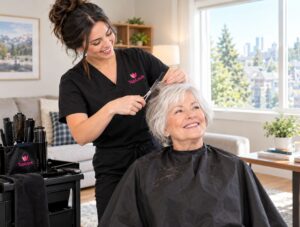
TapLook’s mobile service model addresses this issue by bringing beauty services to the client’s location.
Instead of making a separate trip to a salon, a senior can arrange an appointment at home when the service is available in the area.
This can make personal grooming more accessible while reducing the logistical effort associated with travelling.
For families, this can also be reassuring. A parent may continue enjoying familiar grooming routines without depending entirely on a family member to drive them to a salon.
The value is therefore not limited to beauty.
It is also about maintaining choice and routine.
Why Personal Grooming Matters to Aging at Home
Aging independently involves more than physical survival.
Quality of life can include feeling comfortable, maintaining appearance, staying socially connected, and continuing familiar routines.
A senior who has always enjoyed having their nails professionally cared for may see that appointment as an ordinary and enjoyable part of life.
When mobility or transportation becomes more difficult, bringing the service to the home can remove one barrier.
This is particularly useful when combined with other forms of senior assistance.
For example, a senior could receive transportation assistance for an appointment outside the home while using mobile beauty services for grooming needs at home.
The two approaches solve different problems.
BabaTap can focus on practical everyday assistance and companionship.
TapLook can focus on convenient mobile beauty and personal grooming.
Traditional Senior Home Care providers may address personal care, household support, nursing, or other needs depending on their scope of service.
These services do not necessarily compete with one another. They can occupy different parts of an older adult’s support plan.
Building a Flexible Support System Instead of One Large Solution
One of the most useful ways to think about aging at home is to avoid assuming that one service must solve every problem.
A senior’s needs can change from week to week.
One week may involve several medical appointments.
Another week may require grocery shopping and household assistance.
During winter, transportation may become more important.
At other times, companionship and social outings may be the priority.
Personal grooming may be needed only once every few weeks.
A flexible support model allows assistance to be matched to actual needs.
This is consistent with the wider approach to aging at home in New Brunswick. The provincial system includes different forms of home support and home health services rather than treating every senior as having the same requirements.
Families can therefore consider several questions:
What can the senior comfortably do alone?
Which activities have become difficult?
Which tasks create the greatest safety or transportation concerns?
Does the senior need medical care, non-medical assistance, companionship, or a combination?
How often is assistance required?
Would occasional hourly support be sufficient?
Could mobile services eliminate unnecessary travel?
These questions can help families build a support arrangement around the senior’s actual lifestyle.
The Difference Between Medical Care and Non-Medical Support
Families searching online for Home Care for Seniors may encounter many different providers and service descriptions.
It is important to understand what each service actually provides.
Medical home care may involve nurses, clinical assessments, rehabilitation, wound care, medication-related services, or other health services.
Personal care may involve activities such as bathing, dressing, grooming, or toileting.
Home support may include meal preparation, housekeeping, errands, or assistance with daily activities.
Companion services generally focus on social interaction, practical assistance, transportation, errands, and everyday support rather than medical treatment.
Mobile beauty services have a different purpose again. They bring professional grooming services directly to a client’s location.
These categories can overlap in a senior’s overall support network, but they should not be treated as interchangeable.
New Brunswick’s public home care system distinguishes between Extra-Mural Program home health services and home support services, each with different functions and administration.
For families in Saint John, understanding this distinction can make conversations with providers much more productive.
Instead of simply asking for “home care,” a family can describe the exact assistance their parent needs.
That may be transportation.
It may be grocery support.
It may be companionship.
It may be light household assistance.
It may be personal grooming.
Or it may involve professional medical care.
The clearer the need, the easier it becomes to identify an appropriate service.
Saint John Families Have Multiple Aging-at-Home Resources
The local support environment extends beyond private service providers.
Saint John’s community resources include directories and organizations that help seniors and families navigate available programs.
The Human Development Council’s Seniors’ Directory provides information about community programs for seniors in Saint John and directs residents to 211 for assistance finding social services.
New Brunswick also provides information about home support, long-term care, caregiver services, adult day programs, and other resources designed to support older adults.
This means families do not necessarily need to view aging at home as an all-or-nothing decision.
A senior does not have to choose between doing everything alone and immediately moving into residential care.
There can be a middle ground.
That middle ground may involve occasional companionship, transportation, household help, mobile grooming, community programs, family assistance, and formal home support where appropriate.
The goal is to create enough support for the senior to continue participating in daily life while respecting personal preferences and existing abilities.
Creating a More Comfortable Daily Routine
Independence is often built from small routines.
Getting dressed in the morning.
Preparing breakfast.
Reading the newspaper.
Going grocery shopping.
Visiting friends.
Attending appointments.
Having a coffee with a companion.
Getting a manicure or pedicure.
Keeping the home comfortable.
Calling family members.
These activities may seem ordinary, but together they form a person’s sense of normal life.
When one or two tasks become difficult, the entire routine can become harder.
Practical support can remove those obstacles.
This is why the combination of TapLook and BabaTap can be understood as part of a broader aging-at-home strategy in Saint John.
BabaTap can help address practical and social needs.
TapLook can help make personal grooming more convenient.
Other community and home support services can address additional needs depending on eligibility, availability, and the senior’s circumstances.
The result is not dependence.
Instead, the right support can help an older adult preserve more of the independence they already have.
Looking Ahead: A Personalized Approach to Aging at Home
Every senior has a different lifestyle, family situation, home environment, and level of support.
Some people need only occasional help.
Others may require regular assistance with household activities.
Some may need medical or personal care in addition to non-medical support.
The important step is identifying what kind of help is actually needed.
For Saint John families, this can mean looking beyond the broad phrase “home care” and considering the full range of services available.
Senior Home Care can involve formal support programs.
Companion Care for Seniors can address practical and social needs.
Mobile beauty services can make grooming easier.
Transportation can help seniors continue attending appointments and participating in community life.
Family members can remain involved without having to personally handle every task.
In this context, the idea behind How TapLook and BabaTap Help Seniors Live Independently at Home in Saint John is not that one service can meet every senior’s needs. Rather, it is that different forms of practical support can work together around the senior’s existing lifestyle.
For an older adult who wants to remain at home, independence may simply mean having the right assistance at the right time while continuing to make their own everyday choices.

How TapLook and BabaTap Can Work Together for Seniors in Saint John
The needs of an older adult are rarely limited to one category. A senior may be perfectly capable of preparing meals and managing personal finances but may find grocery shopping physically tiring. Another senior may manage household routines independently but no longer feel comfortable driving. Someone else may be able to live alone safely while appreciating regular companionship and assistance with errands.
This is why a flexible combination of services can be valuable.
BabaTap and TapLook serve different practical purposes, allowing families to consider support based on the specific needs of their parent or loved one.
BabaTap can provide practical assistance and companionship for everyday activities. This may include transportation, grocery shopping, errands, household assistance, and spending time with a senior.
TapLook focuses on mobile beauty and grooming services that can be provided at the client’s location.
When these services are considered alongside community programs and formal home support, families can create a more comprehensive approach to aging at home.
The goal is not to replace a senior’s independence.
The goal is to make independence more sustainable.
Transportation Can Make Independent Living More Practical
Transportation is one of the most important parts of independent living.
A senior may still want to attend medical appointments, visit friends, shop for groceries, go to a community event, or spend time with family. If driving becomes difficult or public transportation is inconvenient, these ordinary activities can become harder.
Transportation assistance can remove one of those barriers.
For example, an older adult in Saint John may need assistance getting to a medical appointment. Instead of cancelling the appointment because a family member is unavailable, the senior may arrange appropriate transportation support.
The same principle can apply to everyday errands.
A grocery trip is not simply about buying food. It may be part of a senior’s weekly routine and an opportunity to leave home and remain connected to the community.
Companionship during transportation can also provide additional reassurance for seniors who do not enjoy travelling alone.
However, families should always distinguish ordinary transportation and companionship from medical transportation or services requiring clinical supervision. The appropriate service depends on the person’s mobility, health needs, and level of assistance required.
Grocery Shopping and Errands for Older Adults
Grocery shopping is another area where small amounts of assistance can have a significant practical effect.
A senior may know exactly what they want to buy but have difficulty carrying bags, navigating a large store, or arranging transportation.
An hourly companion or helper can assist with the practical aspects of the trip while allowing the senior to remain involved in the decisions.
This distinction is important.
Independent living does not mean that a senior must physically perform every task without assistance.
A senior can still choose groceries, decide what meals to prepare, manage a shopping list, and make purchasing decisions while receiving help with transportation or carrying items.
BabaTap’s model of practical senior assistance can be relevant to these situations because its services are designed around everyday support rather than treating every senior as requiring full-time care.
The same approach can apply to pharmacies, post offices, banks, community centres, and other routine destinations, depending on the service arrangement and the senior’s needs.
Household Assistance Without Taking Away Independence
Household tasks can gradually become more demanding.
Vacuuming, organizing rooms, changing linens, preparing simple meals, or completing small errands may take more time as a person gets older.
A senior may still want to remain responsible for their home but appreciate assistance with the tasks that are physically demanding.
This is where household support can complement independent living.
New Brunswick’s home support framework recognizes services such as light housekeeping and meal assistance among the types of support that may help eligible individuals remain at home. (www2.gnb.ca)
Private companion services can provide another option for certain practical needs, depending on the provider and service arrangement.
Families should ask clear questions about exactly what a provider can and cannot do.
For example:
Can the provider help with light household tasks?
Can they accompany the senior while shopping?
Can they provide transportation?
Can they stay with the senior for several hours?
Can they help with errands?
Does the service include personal care?
Is medical care provided?
These questions help prevent confusion between companion assistance, home support, personal care, and healthcare.
Maintaining Social Connections in Saint John
Independent living is not only about staying physically safe at home.
Social connection also matters.
An older adult who rarely leaves the house may gradually lose opportunities for conversation, recreation, and community participation.
Regular companionship can help make daily life more engaging.
A companion might accompany a senior to a community activity, help with a shopping trip, sit and talk, or simply provide another person to share part of the day with.
Saint John’s community organizations provide various programs intended to support seniors and encourage social participation. The Human Development Council’s Seniors’ Directory is one local resource for finding information about programs and services available to older adults. (sjhdc.ca)
Community connection can be particularly important for seniors whose family members live outside Saint John.
A son or daughter may want to visit frequently but cannot be physically present every day.
A companion can provide practical support between family visits while allowing relatives to remain involved from a distance.
Mobile Beauty Services Can Support Personal Routines
Personal grooming is often overlooked when families discuss aging at home.
Yet grooming can contribute to confidence and personal identity.
Many seniors have maintained the same beauty and self-care routines for decades. These routines may include nail care, manicures, pedicures, hair appointments, skincare, or other personal services.
When transportation becomes difficult, the senior may gradually stop participating in these routines.
A mobile service can reduce that barrier.
TapLook’s mobile beauty concept allows beauty professionals to travel to the client’s location rather than requiring the client to travel to a salon.
For seniors, this can mean greater convenience.
The appointment takes place in a familiar environment.
The senior does not need to arrange a separate trip.
Family members may not need to spend additional time driving to and from a salon.
This can be especially useful for seniors who prefer staying at home but still want to maintain their personal grooming habits.
Personal Choice Is an Important Part of Aging Independently
One of the strongest principles behind aging at home is personal choice.
An older adult should ideally remain involved in decisions about their daily routine whenever their circumstances allow.
That can include choosing when to receive assistance, what errands to complete, where to go, who to spend time with, and which personal services they enjoy.
Support should therefore be designed around the senior rather than forcing the senior into a predetermined routine.
For example, a senior may want companionship only twice a week.
Another person may need transportation every Tuesday.
Someone else may prefer mobile grooming services at home because travelling to a salon has become inconvenient.
A flexible approach allows these differences to be respected.
This is particularly relevant when families begin searching for Home Care for Seniors and discover that the phrase covers many different service models.
Instead of selecting a service simply because it uses the term “home care,” families can first identify the actual needs of the older adult.
How Families Can Assess a Senior’s Needs
A practical assessment does not have to be complicated.
Families can begin by observing what has changed in the senior’s normal routine.
Has the senior stopped driving?
Are grocery trips becoming difficult?
Are appointments being missed?
Does the senior spend most days alone?
Is housekeeping becoming overwhelming?
Does the senior avoid social activities because transportation is difficult?
Has the senior stopped going to the salon because travelling is inconvenient?
Does the senior need medical or personal care beyond companionship?
These questions can help separate different categories of assistance.
For example, transportation may solve one problem while companionship solves another.
Household assistance may reduce physical strain.
Mobile beauty services may restore a familiar grooming routine.
Formal home support may be appropriate when a senior needs assistance with personal care or other activities covered by a specific program.
The result can be a support plan that is proportional to the senior’s actual needs.
A Typical Day With Practical Senior Support
Consider a hypothetical Saint John senior who lives independently in a familiar home.
The senior can prepare breakfast, take medication as instructed, communicate with family, and manage most household decisions.
However, driving has become inconvenient.
On Monday, a companion helps with grocery shopping.
On Wednesday, the senior has an appointment and receives appropriate transportation assistance.
On Friday, a companion spends a few hours helping with errands and providing social company.
Later in the month, a TapLook professional visits the senior’s home for a scheduled beauty appointment.
None of these services necessarily changes where the senior lives.
Instead, they remove specific obstacles.
The senior remains at home.
The senior continues deciding what to purchase, where to go, and how to spend time.
The support simply makes those choices easier to carry out.
This is an example of how Senior Home Care can exist within a broader network of practical services rather than being understood as one single type of care.
Supporting Family Caregivers in Saint John
Families often want to help their parents as much as possible.
However, family caregivers have their own work, children, responsibilities, and commitments.
When every transportation trip, grocery run, appointment, and household task falls on one family member, the arrangement may become difficult to maintain.
Using appropriate outside support can distribute some of those responsibilities.
This does not mean that families become less involved.
Instead, family members may have more time to focus on meaningful relationships.
A daughter may be able to visit her mother for conversation rather than spending the entire visit cleaning and shopping.
A son may be able to spend quality time with his father instead of using the entire weekend for transportation and errands.
A family member living outside Saint John may feel more comfortable knowing that their parent has access to practical support when they cannot be there.
This can make an aging-at-home arrangement more sustainable for everyone involved.
When Families Should Consider Additional Professional Care
Companion services and mobile beauty services are not substitutes for medical care.
Families should pay attention when a senior’s needs become more complex.
Changes in mobility, difficulties with personal hygiene, medication concerns, repeated falls, significant confusion, inability to prepare meals safely, or other concerning changes may require professional assessment.
New Brunswick provides different pathways for home health and home support services. The Extra-Mural Program provides health services in the home for eligible individuals, while home support programs can assist with activities of daily living and other practical needs. (nbhc.ca)
When a senior’s needs exceed what a companion or non-medical helper can safely provide, families should contact the appropriate healthcare or community service organization.
The key is understanding the difference between supportive companionship and professional healthcare.
BabaTap can be considered for practical and social assistance.
TapLook can be considered for mobile beauty services.
Formal healthcare and home support programs may be appropriate for more complex needs.
Each has a different role.
Questions to Ask Before Arranging Senior Services
Before booking any service, families can prepare a short list of questions.
What exactly does the service include?
Ask whether the provider offers transportation, errands, companionship, housekeeping, grooming, personal care, or other assistance.
Is the service medical or non-medical?
This distinction is particularly important when a senior has health-related needs.
Can the service be arranged hourly?
Some families need only a few hours of support rather than daily or full-time care.
Can the senior remain involved in decisions?
The service should fit the senior’s routine and preferences.
Is the provider available in the senior’s Saint John neighbourhood?
Service coverage can vary.
What happens if the senior’s needs change?
Families may want to know whether the provider can accommodate changing schedules or whether another type of service should be considered.
Does the provider have clear policies for safety and communication?
Families should understand how appointments, cancellations, emergencies, and communication with relatives are handled.
Asking these questions before beginning a service can help create clearer expectations.
Combining Community Resources With Private Support
Families do not necessarily need to rely on one organization.
A senior may use public home support for eligible services, community programs for social activities, a private companion for errands, and TapLook for mobile grooming.
This layered approach can be useful because different organizations specialize in different needs.
New Brunswick’s community resource network includes 211 New Brunswick, which provides information about available programs and services. Saint John’s Human Development Council also maintains senior-focused community information. (sjhdc.ca)
Families can therefore explore both formal and informal options before deciding what combination fits their circumstances.
The right arrangement can change over time.
A senior may need very little assistance today but more support six months later.
Alternatively, temporary support may be enough following a period of reduced mobility or a change in transportation needs.
Why Aging at Home Can Be a Gradual Process
Aging at home does not have to be treated as a single permanent decision.
It can be a gradual process.
A senior may begin with occasional transportation.
Later, they may add grocery assistance.
Then they may benefit from regular companionship.
A mobile beauty service can help maintain personal routines throughout the process.
If needs become more significant, families can investigate additional home support or healthcare services.
This gradual approach allows families to respond to real changes rather than assuming in advance that a senior will require a particular level of care.
It also gives the older adult more opportunity to remain involved in decisions about their own life.
How TapLook and BabaTap Fit Into the Bigger Picture
The idea behind How TapLook and BabaTap Help Seniors Live Independently at Home in Saint John can be summarized through complementary roles.
BabaTap focuses on practical everyday support and companionship.
TapLook focuses on mobile beauty and grooming services.
Community organizations can provide social programs and information.
Transportation providers can help seniors remain mobile.
Government-supported home support and healthcare services can address eligible needs that require a different level of assistance.
Together, these different resources demonstrate that independent living does not have to mean complete isolation or doing every task alone.
A senior can remain in a familiar home while receiving carefully selected support.
The Role of Dignity in Senior Support
Dignity should remain central to conversations about aging.
An older adult is not defined only by the tasks they can or cannot complete.
They have preferences, habits, relationships, memories, and personal routines.
A supportive service should recognize that.
Helping someone with groceries does not mean taking away their ability to choose what they eat.
Providing transportation does not mean deciding where they should go.
Offering companionship does not mean replacing family relationships.
Bringing a beauty service into the home does not mean treating the senior as incapable of travelling.
Instead, these services can remove practical barriers while preserving personal choice.
This distinction is especially important when families discuss Home Care for Seniors.
The objective should be to understand what assistance is needed while continuing to recognize the senior as an active participant in their own life.
A Practical Model for Families in Saint John
Families considering support for an older adult can think about the process in five stages.
First, identify the senior’s current abilities.
Second, identify the tasks that have become difficult.
Third, determine whether each task requires medical care, personal care, practical assistance, transportation, companionship, or another service.
Fourth, explore appropriate local resources and providers.
Fifth, review the arrangement periodically as circumstances change.
This model avoids automatically choosing the most intensive form of care.
It also avoids waiting until a small problem becomes a major obstacle.
For example, if transportation is becoming difficult, arranging occasional assistance early may allow the senior to continue attending appointments and social activities.
If grooming appointments have become difficult because of transportation, mobile beauty services may provide an alternative.
If loneliness or lack of practical help is becoming a concern, Companion Care for Seniors may be worth exploring.
If personal or medical needs increase, families can investigate professional home support or healthcare services.
Frequently Asked Questions About Senior Support in Saint John
What is Senior Home Care?
Senior Home Care is a broad term that can refer to different types of assistance provided in or around an older adult’s home. Depending on the provider, it may include personal care, household assistance, meal support, companionship, transportation, or healthcare services. Families should confirm the exact services offered by each provider.
Is Companion Care for Seniors the same as medical care?
No. Companion services generally focus on social interaction and practical everyday assistance. Medical care involves qualified healthcare professionals and services that address health-related needs.
Can BabaTap help seniors with everyday errands?
BabaTap’s senior-focused services include practical assistance such as transportation, grocery shopping, errands, household help, and companionship, subject to the specific service arrangement and availability. (babatap.com)
Why might mobile beauty services be useful for seniors?
Mobile beauty services can reduce the need to travel to a salon. For seniors who find transportation inconvenient, receiving grooming services at home can make it easier to continue familiar personal care routines.
Can seniors use several services at the same time?
Potentially, yes. A senior may use different services for different needs. For example, a person could use a companion service for errands, a transportation service for appointments, a community program for social activities, and a mobile beauty provider for grooming.
Where can Saint John families find information about local senior services?
211 New Brunswick provides information about community and social services, while the Human Development Council’s Seniors’ Directory provides information relevant to seniors in Saint John. (sjhdc.ca)
When should a family consider additional professional support?
If an older adult develops needs involving personal care, health management, mobility, safety, or other issues beyond the scope of a companion service, families should consider discussing those needs with an appropriate healthcare professional or home support organization.
Final Thoughts on Aging Independently at Home in Saint John
Living independently at home can mean different things to different seniors.
For one person, independence may mean being able to choose when to go grocery shopping.
For another, it may mean continuing to attend appointments without relying exclusively on family members.
For someone else, it may mean having a trusted companion for errands or maintaining a favourite grooming routine.
The important point is that assistance and independence are not opposites.
With the right support, an older adult can receive help with selected tasks while continuing to make everyday decisions and remain connected to the people and places that matter.
In Saint John, families have access to a combination of government programs, community resources, transportation options, companion services, and specialized providers.
BabaTap can contribute practical assistance and companionship for everyday needs.
TapLook can make personal grooming more convenient through mobile beauty services.
Other providers and public programs can address additional home support, personal care, or healthcare requirements.
Together, these options can help families think about aging at home as a flexible support system rather than a single service.
The purpose is not to do everything for a senior.
It is to identify the areas where assistance is useful, preserve the activities the senior can still manage, and make everyday life more convenient without unnecessarily disrupting the familiar home environment.
For many families, that balance is an important part of supporting an older adult’s independence, comfort, dignity, and connection to the Saint John community.
Bài viết liên quan: