
How TapLook and BabaTap Help Seniors Live Independently at Home in Calgary. For many older adults in Calgary, living independently at home is about much more than having a place to live. It is about maintaining familiar routines, staying connected to the community, getting to appointments, keeping the home comfortable, managing everyday errands, and having dependable support when family members cannot be there. For seniors returning home after a hospital stay, these needs can become even more important. A discharge from a hospital such as Rockyview General Hospital, Foothills Medical Centre, South Health Campus, or another Calgary healthcare facility may mark the beginning of a new period in which an older adult needs practical assistance while adjusting to life at home. This is where transportation, companionship, household support, personal grooming, and everyday assistance can work together to make independent living more manageable. In Calgary, families may encounter a range of services connected with Senior Home Care, Home Care for Seniors, aging in place, community support, senior transportation, and companion services. Alberta Health Services provides formal Home Care for people who need medical support at home, while the City of Calgary also provides information about senior programs, transportation resources, home support, and community services. TapLook and BabaTap address a different but complementary side of senior independence. TapLook can help older adults access practical beauty and personal grooming services, while BabaTap focuses on non-medical companionship and practical everyday assistance such as transportation, grocery shopping, household help, and errands. Together, these services can help families build a broader support system around an aging parent. Meanwhile, RideSenior can address a particularly important transition point: non-medical transportation from a hospital to the senior’s home after discharge, including situations where a driver needs to go to the hospital ward, complete the required pickup process, escort the patient from the ward, and bring them safely to the waiting vehicle. For families planning long-term independence at home, understanding how these different services fit together can make the transition from hospital to home more organized, comfortable, and practical.

Why Independent Living Matters to Seniors in Calgary
For many older adults, home represents stability.
It may be the place where they have lived for decades, where their belongings are familiar, where neighbours recognize them, and where daily routines feel predictable. Moving into a retirement residence, assisted living community, or long-term care setting may be appropriate for some seniors, but it is not automatically the preferred solution for every older adult.
A senior who can remain at home safely may benefit from maintaining familiar surroundings and continuing everyday routines.
Independent living, however, does not necessarily mean doing everything alone.
This distinction is important for families.
A senior may be physically capable of living at home but still need assistance with transportation, groceries, household tasks, appointments, errands, companionship, or personal grooming.
That is where a broader senior support network becomes useful.
Calgary has a variety of programs and resources for older adults and caregivers. The City of Calgary provides information covering transportation, social isolation, housing, home support, safety, and other senior-related resources.
Families can therefore think about independent living as a combination of different types of support rather than relying on one service to solve every problem.
For example, a senior may need:
Transportation after a hospital discharge
Transportation to medical or personal appointments
Help shopping for groceries
Assistance with household errands
Companionship during everyday activities
Help maintaining personal grooming
Support with light household tasks
Someone to accompany them when family members are working
A dependable person to help them remain socially connected
This approach can be particularly valuable when adult children live in another part of Calgary, another province, or another country.
Understanding Senior Home Care in Calgary
The term Senior Home Care can mean different things depending on the provider.
In Alberta, formal Home Care is connected with healthcare needs. Alberta’s official health information describes Home Care as support for people living at home who need medical assistance, including services such as care after surgery, short-term and long-term care, palliative care, respite services, and certain equipment loans. Services are assessed according to individual needs.
This is different from non-medical practical assistance.
A family may use formal healthcare services for clinical needs while separately arranging transportation, companionship, grocery assistance, housekeeping, errands, or personal grooming.
This distinction helps families choose the right type of support.
A senior who requires nursing care should be connected with an appropriate healthcare provider. A senior who primarily needs someone to drive them to the grocery store, accompany them to an appointment, help with errands, or provide practical companionship may need a different kind of service.
This is where BabaTap can become part of the conversation.
What BabaTap Adds to Independent Living
BabaTap is designed around practical, non-medical support for seniors.
The concept is straightforward: an older adult may not need medical care but may still need another person nearby to make everyday life easier.
For example, an aging parent might be able to prepare meals but have difficulty getting groceries.
They may be able to live in their own house but find certain household chores increasingly difficult.
They may be able to attend an appointment but need someone to drive them.
They may be independent during most of the week but appreciate having a companion for errands or community activities.
BabaTap can help address these practical situations through services such as transportation, grocery shopping, household cleaning, errands, and companionship.
This can complement formal healthcare without pretending to replace it.
That distinction is important because non-medical companion services and professional healthcare services have different roles.
Families searching for Home Care for Seniors may therefore discover that their parent does not necessarily need a full medical home-care arrangement for every part of daily life.
Instead, the family may need a combination of professional healthcare and non-medical practical support.
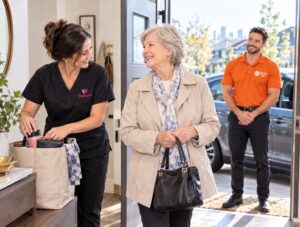
Why Companion Support Can Make a Difference
Companion Care for Seniors can address a need that is sometimes overlooked when families focus exclusively on medical requirements.
An older adult can have stable medical needs and still experience practical difficulties.
They may spend long periods alone.
They may stop going to stores because transportation has become difficult.
They may avoid social activities because they do not want to travel alone.
They may postpone household tasks because those tasks have become physically demanding.
They may rely heavily on adult children for small everyday requests.
A companion can help reduce some of these practical barriers.
The purpose is not to take away independence.
In many situations, the purpose is to make independence more achievable.
There is a meaningful difference between doing everything for a senior and helping a senior continue doing things they want to do.
For example, accompanying an older adult to a grocery store may allow that person to continue choosing their own food instead of having someone else make all the decisions.
Driving a senior to an appointment may allow them to continue attending activities independently rather than becoming dependent on family members’ schedules.
Helping with an errand can preserve the senior’s routine without requiring a move away from home.
TapLook and the Importance of Personal Grooming
Personal grooming is another part of independent living that can easily be overlooked.
A senior’s ability to maintain their preferred appearance can influence confidence, routine, social interaction, and overall sense of normalcy.
TapLook provides a complementary service by connecting seniors with nail and beauty professionals.
For an older adult, something as simple as getting their nails done can be part of a normal weekly or monthly routine.
The importance is not necessarily the beauty treatment itself.
It can be the experience of maintaining personal preferences and continuing familiar habits.
This becomes particularly relevant for seniors who may have reduced mobility or find travelling to a traditional salon increasingly inconvenient.
A service designed around older adults can make personal grooming easier to incorporate into an independent-living routine.
TapLook therefore fits into a broader senior lifestyle ecosystem.
BabaTap can assist with practical everyday needs.
TapLook can support personal grooming and beauty routines.
RideSenior can address transportation during important transitions such as hospital discharge.
Healthcare providers can address medical needs.
Together, these services represent different pieces of the same larger objective: helping an older adult maintain an appropriate level of independence.
The Hospital-to-Home Transition
The period immediately following hospital discharge deserves special attention.
A senior may be medically ready to leave the hospital but still face practical transportation challenges.
A family member may be working.
The senior may not be comfortable using public transportation.
The family vehicle may not be immediately available.
The hospital may have specific procedures concerning where a discharged patient is collected.
This is where non-medical hospital discharge transportation can be useful.
RideSenior is designed around transportation for discharged patients who need to return home.
There are commonly two practical pickup situations.
The first involves a ward-level pickup.
In this situation, the driver goes into the hospital to the patient’s ward or designated discharge area, completes the required pickup process, assists with the patient’s transition from the ward, and escorts the patient down to the vehicle.
For some hospitals and discharge circumstances, this type of pickup is particularly important because the patient is not simply released to walk independently to a vehicle waiting outside.
The second situation involves pickup from a hospital waiting-room or lobby area.
The patient is directed to the designated pickup location, and the driver meets the patient there before taking them home.
For families, knowing which pickup arrangement applies can make hospital discharge planning considerably easier.
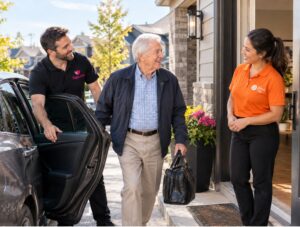
Why Ward-Level Hospital Pickup Can Matter
The ward-level pickup model is particularly relevant for older adults who may have mobility limitations, fatigue, confusion, weakness, or difficulty navigating a large hospital independently.
Imagine an older adult who has just been discharged after several days in hospital.
The family member who normally provides transportation is at work.
The senior has been cleared to return home but does not feel comfortable navigating the hospital alone.
A driver who meets the patient at the appropriate hospital ward can simplify that transition.
The driver can coordinate the pickup, assist with the transition from the ward, escort the senior through the hospital, and accompany them to the vehicle.
This is not medical care.
It is transportation and practical assistance associated with the journey home.
That distinction should be clear to families.
RideSenior is not a replacement for nurses, physicians, rehabilitation professionals, home healthcare providers, or other clinical services.
Instead, it addresses the transportation gap between hospital discharge and arrival at home.
From Hospital Discharge to Independent Living
The transportation ride itself may last only a short time.
But its importance can extend beyond the trip.
The goal of discharge transportation is to help complete the transition from hospital to home.
Once the senior arrives home, other forms of support may become relevant.
For example:
RideSenior can help with the transportation transition.
BabaTap can provide practical non-medical assistance.
TapLook can support personal grooming.
Healthcare providers can address clinical needs.
Family members can coordinate the overall support plan.
This creates a more complete framework for aging in place.
A senior may not need every service every day.
Instead, support can be arranged around actual needs.
That flexibility can be valuable for families who want to encourage independence rather than automatically moving toward full-time institutional care.
Calgary’s Existing Senior Support Environment
Calgary already has a network of programs and organizations serving older adults.
The City of Calgary provides information about senior transportation, home support, housing, social isolation, safety, and community resources. Its senior resources also point residents toward transportation options such as Calgary Transit Access and wheelchair-accessible transportation resources.
The City also provides information about Home Services for Seniors. As of 2026, the City states that this program is transitioning, with its current coordination ending September 30, 2026, and eligible clients moving toward Alberta’s Special Needs Assistance for Seniors program.
This illustrates why families should look at the current availability and eligibility requirements of individual programs rather than assuming that a service will remain unchanged.
For broader community navigation, Calgary also directs residents toward resources such as 211 and The Way In.
The result is a landscape where formal government services, healthcare programs, private services, transportation providers, and community organizations can all play different roles.

Home Care for Seniors Versus Non-Medical Companion Support
Families frequently search for Home Care for Seniors when they notice that an aging parent is having difficulty managing daily life.
However, the search term can cover very different needs.
Some families need nursing or healthcare assistance.
Others primarily need transportation and companionship.
Others need help with household chores or errands.
Some need several of these services at the same time.
Understanding the difference can prevent families from choosing a service that does not match the senior’s actual needs.
Alberta Health Services explains that formal Home Care supports people living at home who need medical support and may involve nurses, healthcare aides, occupational therapists, physiotherapists, social workers, and other healthcare professionals.
Non-medical companion services serve a different purpose.
BabaTap is positioned around practical assistance rather than clinical treatment.
That can include transportation, grocery shopping, household cleaning, errands, and companionship.
The two categories can coexist.
In fact, they may work best together when a senior has both healthcare and everyday practical needs.
When a Senior Needs More Than Transportation
Transportation is often only one piece of the problem.
Consider an older adult who has recently returned home from hospital.
The first challenge may be getting home safely.
That is where RideSenior can help.
Once home, the senior may need groceries.
BabaTap can potentially help with that practical task.
The senior may also want to maintain their regular personal grooming routine.
TapLook can provide a complementary option.
If the senior requires clinical monitoring or healthcare services, formal Home Care may be appropriate.
This illustrates why independent living should be viewed as a system rather than a single service.
The senior’s needs may change from day to day.
One day may require transportation.
Another may require grocery assistance.
Another may simply involve companionship.
The objective is to provide enough support without unnecessarily taking away the senior’s autonomy.
The Role of Family Caregivers
Adult children frequently become informal care coordinators for aging parents.
They may live nearby or far away.
They may have jobs, children, and other responsibilities.
They may want to help but cannot drive across Calgary every time their parent needs groceries or transportation.
This is one reason non-medical senior support services can be valuable.
A family member does not necessarily need to perform every practical task personally.
Instead, the family can coordinate trusted services around the senior.
For example, an adult daughter living in another city may arrange transportation for her parent after a hospital discharge.
She can then organize grocery support through a practical companion service.
She can help schedule a personal grooming appointment.
She can remain involved by phone or video call while local service providers assist with tasks that require someone physically present.
This can make family involvement more sustainable.
Companion Care and Social Connection
Companion Care for Seniors is also relevant to the social side of independent living.
Social isolation can become a concern when older adults stop driving, reduce their activities, or lose access to familiar social routines.
The City of Calgary specifically identifies social isolation as an area for senior resources and support.
Companionship can provide an opportunity for seniors to continue participating in everyday activities.
A companion may accompany a senior while shopping.
They may assist with an errand.
They may accompany the senior to a community activity.
They may simply provide another person to talk with during a practical outing.
The value is not about replacing family relationships.
It is about creating additional opportunities for interaction and participation.
For seniors who want to remain at home, this type of support can help prevent everyday limitations from becoming unnecessary barriers to independence.
Grocery Shopping as a Practical Example
Grocery shopping illustrates the difference between independence and doing everything alone.
A senior may still want to choose their own groceries.
They may know exactly which foods they prefer.
They may have a familiar store and routine.
But carrying groceries, driving, parking, walking through a large store, or managing bags can become difficult.
A companion can help with the practical side while allowing the senior to remain involved in the decision-making process.
This can preserve autonomy.
The senior still decides what they want.
The companion simply helps make the activity more manageable.
This is an important principle when discussing Home Care for Seniors.
Support should not automatically mean taking control.
In many circumstances, good support means enabling an older adult to continue making choices.
Transportation and Aging in Place
Transportation is one of the foundations of independent living.
Without reliable transportation, a senior may gradually stop attending appointments, shopping, visiting friends, participating in activities, or maintaining personal routines.
Calgary provides several transportation-related resources for older adults, including reduced transit fares for people aged 65 and older and specialized transportation options for eligible residents with disabilities.
However, individual situations vary.
A senior who has just been discharged from hospital may need a more direct door-to-door arrangement.
That is where a specialized non-medical transportation provider can play a role.
RideSenior focuses on the journey from the healthcare facility to the senior’s home.
The purpose is not to provide medical treatment during transportation.
The purpose is to make the discharge journey easier to manage.

How RideSenior Fits Into the Larger Picture
RideSenior can be understood as the transportation bridge between hospital and home.
The process can begin when a family learns that an older adult is being discharged.
The family arranges the transportation.
The driver reviews the trip details and confirms the booking.
Depending on the hospital’s discharge process, the driver may go to the patient’s ward or designated pickup area.
For the common ward-level model, the driver can meet the patient at the ward, complete the required pickup process, assist the patient out of the ward, and escort them to the vehicle.
In other cases, the driver can meet the patient in the hospital lobby or waiting area.
The patient is then transported home.
For families, this can remove a major logistical burden during an already stressful transition.
Once the senior arrives home, the focus shifts from transportation to ongoing daily living.
That is where services such as BabaTap and TapLook can become complementary.
Creating a Post-Discharge Routine
The first few days at home can be easier when families plan ahead.
Before discharge, family members can consider:
Who will take the senior home?
Where will the senior be picked up?
Does the hospital require ward-level pickup?
Will the senior need assistance getting from the ward to the vehicle?
Who will be available at home?
Does the senior have groceries?
Will they need help with household tasks?
Who will handle future transportation?
Does the senior need formal Home Care?
Would companionship be helpful?
Does the senior have upcoming appointments?
Does the senior have access to personal grooming services?
These questions do not all have the same answer.
The purpose is to identify which type of support is actually needed.
A Practical Calgary Senior Support Model
A family might create a support structure like this:
RideSenior handles non-medical hospital discharge transportation.
BabaTap helps with practical everyday needs such as errands, grocery shopping, household assistance, and companionship.
TapLook supports personal grooming.
Healthcare professionals handle clinical needs.
Family members remain involved in decision-making and emotional support.
This model allows each service to stay within its appropriate role.
It also helps families avoid assuming that one provider should perform tasks outside its specialization.
Maintaining Independence Without Ignoring Safety
Independence does not mean ignoring risk.
Calgary provides resources addressing fall prevention, home safety, emergency preparedness, and other issues relevant to aging safely at home.
Families should pay attention to changes such as:
Increasing difficulty walking
Repeated falls
Difficulty preparing food
Medication-management problems
Confusion or cognitive changes
Inability to safely use transportation
Difficulty managing household tasks
Sudden changes in personal hygiene
Increasing isolation
When these issues involve healthcare concerns, families should seek appropriate professional assessment.
A companion service should not be expected to replace medical professionals.
Likewise, a transportation provider should not be treated as a healthcare provider.
Clear boundaries make the overall support system safer and more understandable.
Why the Difference Between Medical and Non-Medical Support Matters
One of the most important concepts for families is understanding what each service actually provides.
Alberta’s Home Care system includes healthcare-related services and professional assessment.
BabaTap is different.
Its role is practical, non-medical support.
TapLook is also different.
Its role is centered on personal beauty and grooming services.
RideSenior is different again.
Its focus is transportation, particularly transportation that can help a discharged hospital patient return home.
These differences do not make one category more important than another.
They make the categories complementary.
A senior’s life includes healthcare needs, transportation needs, household needs, social needs, and personal needs.
A well-designed support network recognizes all of them.
Supporting Seniors Who Live Alone in Calgary
A senior who lives alone may especially benefit from advance planning.
The family does not necessarily need someone inside the home every hour.
Instead, the family can establish a predictable network.
For example:
Scheduled transportation
Regular grocery assistance
Periodic companionship
Household support
Personal grooming appointments
Medical follow-up
Emergency contacts
Family check-ins
This approach can give the senior structure while preserving privacy and autonomy.
The exact combination should depend on the senior’s abilities, preferences, health needs, and living environment.
The Importance of Familiarity
One reason aging at home can be attractive is familiarity.
The senior knows where everything is.
They know their neighbourhood.
They know their neighbours.
They may have established relationships with nearby stores, community centres, religious organizations, friends, and family.
Support services can help preserve these connections.
A companion can make it easier to leave the house.
Transportation can make appointments accessible.
Grocery assistance can make shopping manageable.
Personal grooming services can maintain familiar routines.
Hospital discharge transportation can help the senior get back home after an acute healthcare event.
Each individual service may seem small.
Together, they can make a substantial practical difference in daily life.
Planning for the Future
Families should not wait until a crisis occurs to discuss senior support.
An adult child can talk with an aging parent about transportation preferences, household assistance, emergency contacts, appointment routines, and preferred service providers before support becomes urgent.
This can make future transitions easier.
The family can also learn about Calgary’s public resources.
The City of Calgary provides information for seniors and caregivers, including community programs, transportation resources, home support information, housing resources, and social isolation resources.
For healthcare-related Home Care questions, Alberta Health Services provides information about accessing Home Care and community care services.
For general community-resource navigation, Calgary also points residents toward 211 and The Way In.
How TapLook and BabaTap Support the Bigger Picture
TapLook and BabaTap should not be viewed as replacements for formal healthcare.
Their potential value comes from addressing everyday aspects of independent living that exist outside clinical treatment.
BabaTap can help with practical tasks and companionship.
TapLook can support grooming and personal-care routines.
RideSenior can address transportation from hospital to home.
Formal healthcare providers can manage medical needs.
Family members can coordinate and support the senior.
This creates a more complete ecosystem.
For an aging parent, independence is rarely about one service.
It is about having enough support in the right places.
A Family-Centered Approach to Senior Independence
The most effective support plan begins with the senior.
What does the senior want?
What activities matter most?
What can they still do comfortably?
What tasks have become difficult?
What kind of help do they accept?
What kind of help do they prefer?
These questions matter because independence is personal.
Two seniors of the same age may have completely different needs.
One may need only transportation.
Another may require daily clinical care.
Another may need grocery assistance and companionship.
Another may need personal grooming support.
A flexible service network allows families to respond to these differences.
Final Thoughts
Living independently at home in Calgary does not have to mean that an older adult handles every challenge without assistance.
Independence can mean having the right support while continuing to make personal decisions and maintain familiar routines.
For seniors returning home after hospitalization, the first step may be getting from the hospital to home safely and comfortably. RideSenior can help address that non-medical transportation need, including the common situation in which a driver goes directly to the hospital ward, completes the required pickup process, assists the patient from the ward, and escorts them to the vehicle. In other situations, pickup may take place at a designated hospital lobby or waiting area.
Once the senior is home, the needs may change.
BabaTap can provide practical non-medical support such as transportation, grocery shopping, household assistance, errands, and companionship.
TapLook can help seniors maintain personal grooming routines and access beauty services in a way that fits into their lifestyle.
Formal healthcare providers remain responsible for healthcare and clinical needs. Alberta Health Services’ Home Care program is specifically designed for people living at home who require medical support and is based on individual assessment.
This distinction is important.
Senior independence is not about replacing healthcare with companionship.
It is about recognizing that healthcare is only one part of an older adult’s life.
Transportation matters.
Groceries matter.
Household tasks matter.
Personal grooming matters.
Social connection matters.
Family coordination matters.
And having a reliable way to return home after hospital discharge matters.
For Calgary families exploring Home Care for Seniors, Senior Home Care, transportation for older adults, and practical aging-at-home solutions, a combination of services may provide a more flexible approach than relying on one type of assistance.
Companion Care for Seniors can help address everyday social and practical needs while preserving a senior’s involvement in their own routines.
TapLook, BabaTap, and RideSenior each address different parts of that journey.
When those roles are clearly understood, families can create a support plan that is practical, flexible, and centered on the senior’s desire to remain connected to home and community.
Ultimately, helping a senior live independently is not about doing everything for them.
It is about making it possible for them to continue doing the things that matter to them, with appropriate support when they need it.
For an older adult in Calgary, that may mean returning home from hospital with dependable transportation, having someone available for groceries and errands, maintaining personal grooming, staying connected with the community, and receiving professional healthcare when medical needs arise.
That is the broader meaning of aging in place: not simply staying in a house, but continuing to live a meaningful daily life with the right support around it.
Bài viết liên quan: